
Tight local approximation results for max-min linear programs
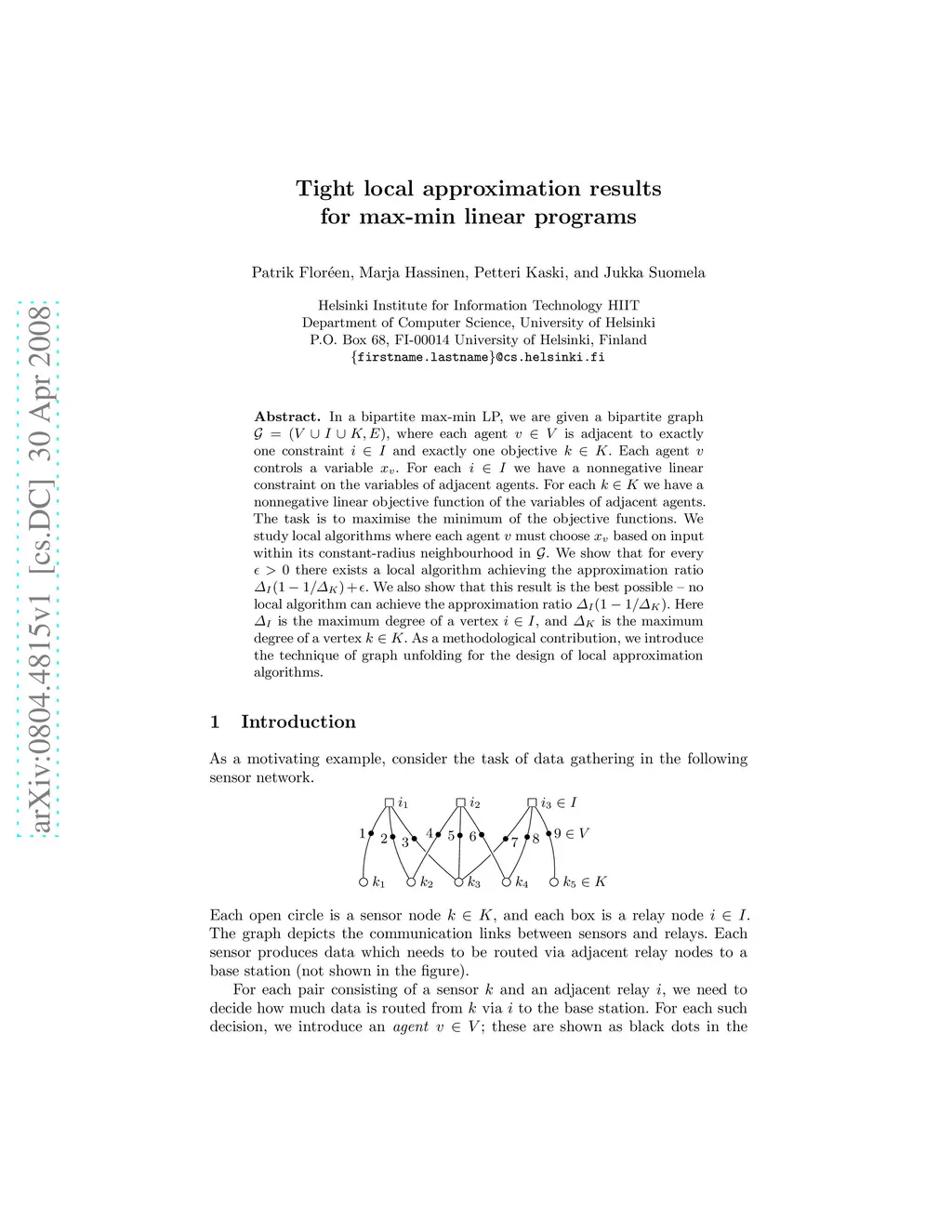
In a bipartite max-min LP, we are given a bipartite graph , where each agent is adjacent to exactly one constraint and exactly one objective . Each agent controls a variable . For each we have a nonnegative linear constraint on the variables of adjacent agents. For each we have a nonnegative linear objective function of the variables of adjacent agents. The task is to maximise the minimum of the objective functions. We study local algorithms where each agent must choose based on input within its constant-radius neighbourhood in . We show that for every there exists a local algorithm achieving the approximation ratio . We also show that this result is the best possible -- no local algorithm can achieve the approximation ratio . Here is the maximum degree of a vertex , and is the maximum degree of a vertex . As a methodological contribution, we introduce the technique of graph unfolding for the design of local approximation algorithms.
View on arXiv