
The Dantzig selector and sparsity oracle inequalities
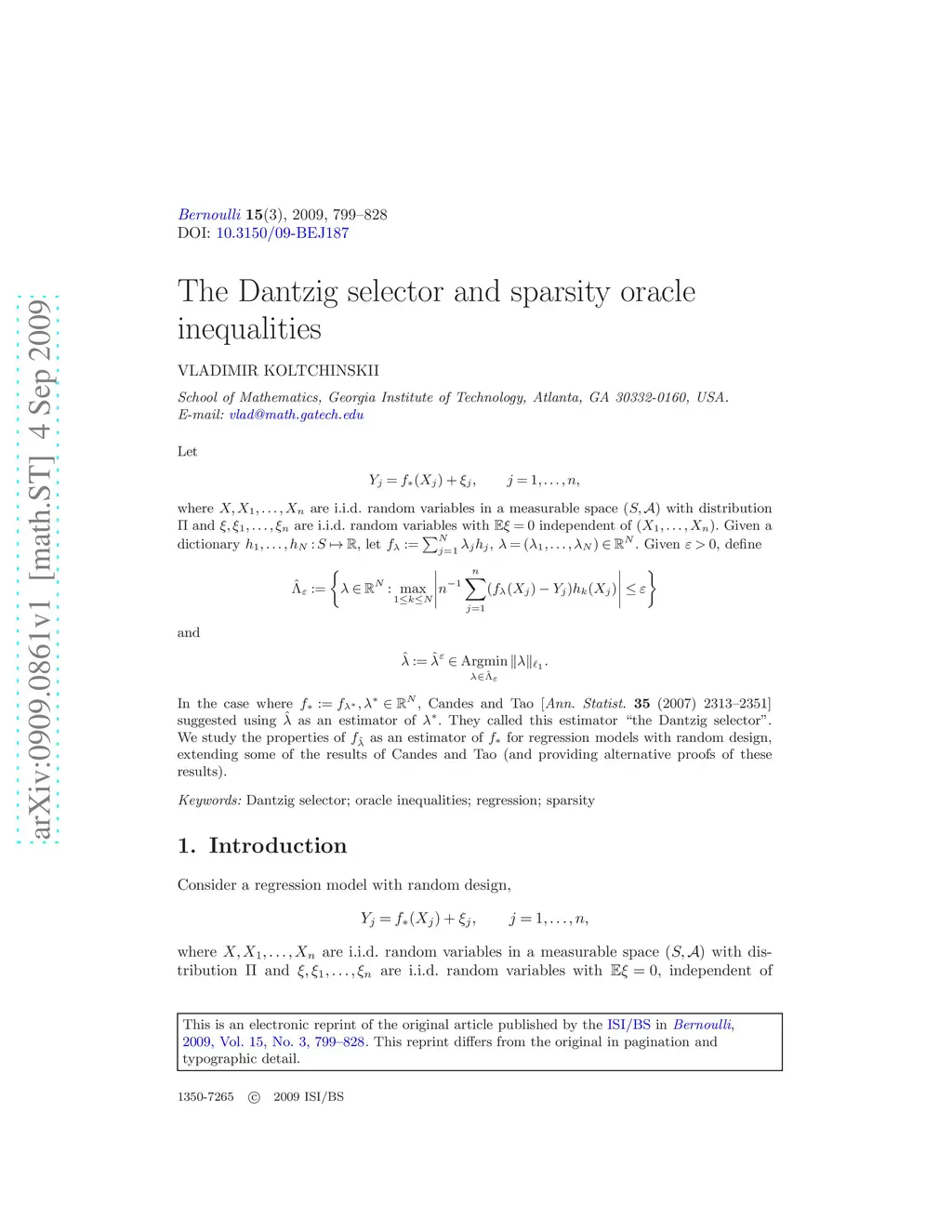
Let \[Y_j=f_*(X_j)+\xi_j,\qquad j=1,...,n,\] where are i.i.d. random variables in a measurable space with distribution and are i.i.d. random variables with independent of Given a dictionary let , Given define \[\hat{\Lambda}_{\varepsilon}:=\Biggl\{\lam bda\in{\mathbb{R}}^N:\max_{1\leq k\leq N}\Biggl|n^{-1}\sum_{j=1}^n\big l(f_{\lambda}(X_j)-Y_j\bigr)h_k(X_j)\Biggr|\leq\varepsilon \Biggr\}\] and \[\hat{\lambda}:=\hat{\lambda}^{\varepsilon}\in \operatorname {Arg min}\limits_{\lambda\in\hat{\Lambda}_{\varepsilon}}\|\lambda\|_{\ell_1}.\] In the case where Candes and Tao [Ann. Statist. 35 (2007) 2313--2351] suggested using as an estimator of They called this estimator ``the Dantzig selector''. We study the properties of as an estimator of for regression models with random design, extending some of the results of Candes and Tao (and providing alternative proofs of these results).
View on arXiv