
A Berry Esseen Theorem for the Lightbulb Process
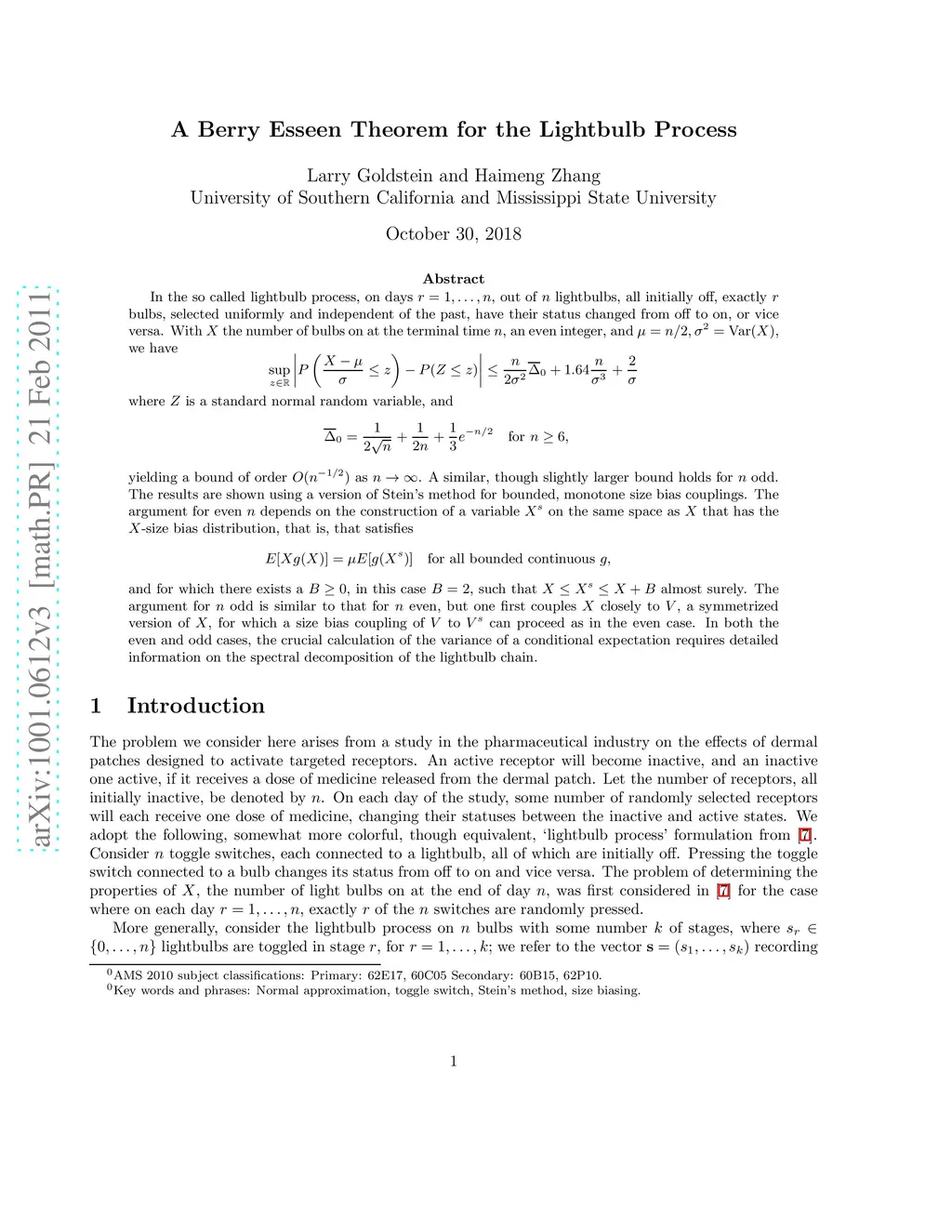
In the so called lightbulb process, on days , out of lightbulbs, all initially off, exactly bulbs, selected uniformly and independent of the past, have their status changed from off to on, or vice versa. With the number of bulbs on at the terminal time , an even integer, and , we have where $$ \Delta_0 \le \frac{1}{2\sqrt{n}} + \frac{1}{2n} + e^{-n/2} \qmq {for ,} $$ yielding a bound of order as . A similar, though slightly larger bound holds for odd. The results are shown using a version of Stein's method for bounded, monotone size bias couplings. The argument for even depends on the construction of a variable on the same space as which has the size bias distribution, that is, that satisfies E X g(X)=\mu Eg(X^s) \quad for all bounded continuous , and for which there exists a , in this case B=2, such that almost surely. The argument for odd is similar to that for even, but one first couples closely to , a symmetrized version of , for which a size bias coupling of to can proceed as in the even case.
View on arXiv