
Learning Human Activities and Object Affordances from RGB-D Videos
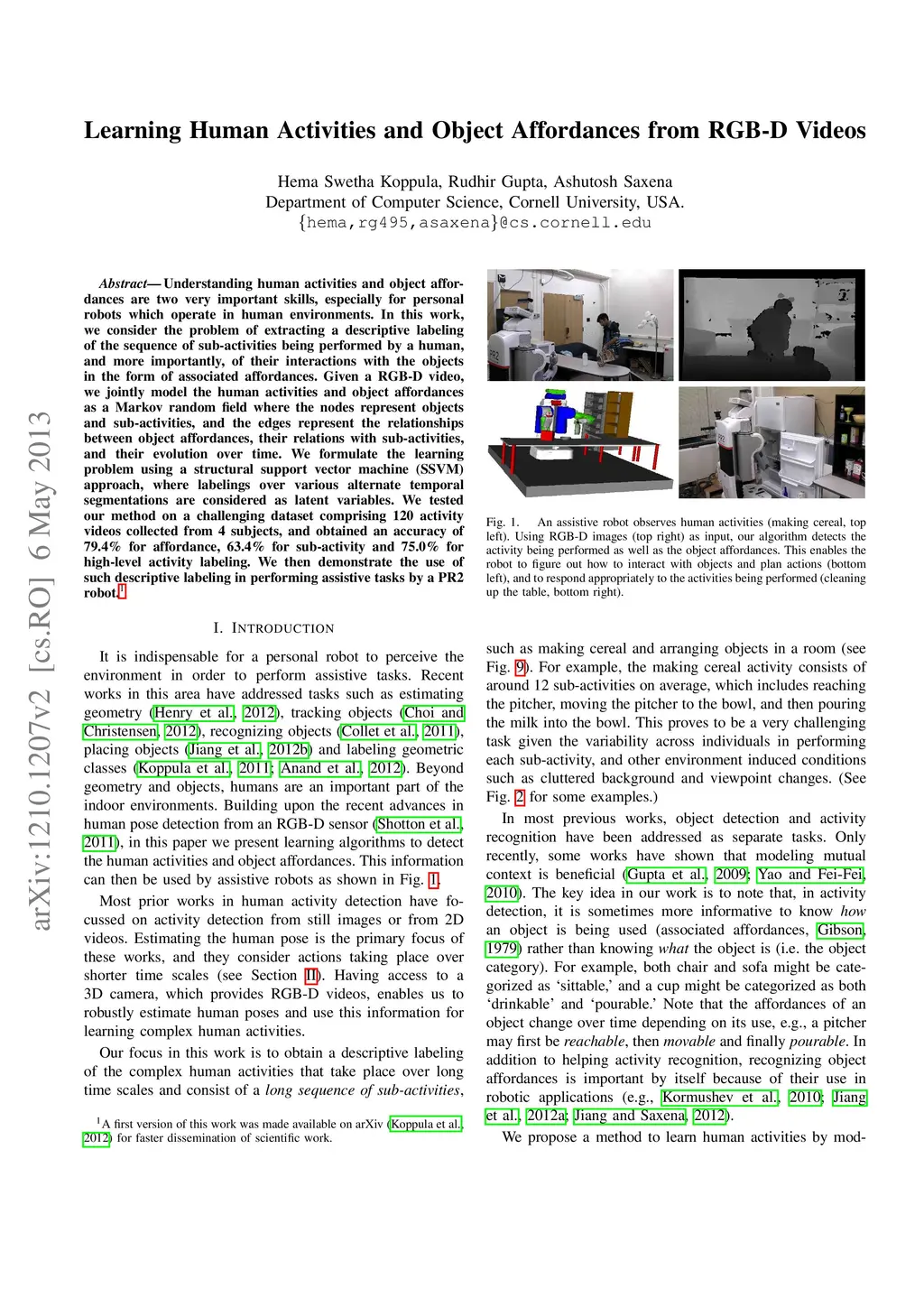
Understanding human activities and object affordances are two very important skills, especially for personal robots which operate in human environments. In this work, we consider the problem of extracting a descriptive labeling of the sequence of sub-activities being performed by a human, and more importantly, of their interactions with the objects in the form of associated affordances. Given a RGB-D video, we jointly model the human activities and object affordances as a Markov Random Field where the nodes represent objects and sub-activities, and the edges represent the relationships between object affordances, their relations with sub-activities, and their evolution over time. We formulate the learning problem using a structural SVM approach, where labeling over various alternate temporal segmentations are considered as latent variables. We tested our method on a challenging dataset comprising 120 activity videos collected from four subjects, and obtained an end-to-end precision of 75.8% and recall of 74.2% for labeling the activities. We then demonstrate the use of such descriptive labeling in performing assistive tasks by a PR2 robot.
View on arXiv