
A new key establishment protocol and its application in pay-TV systems
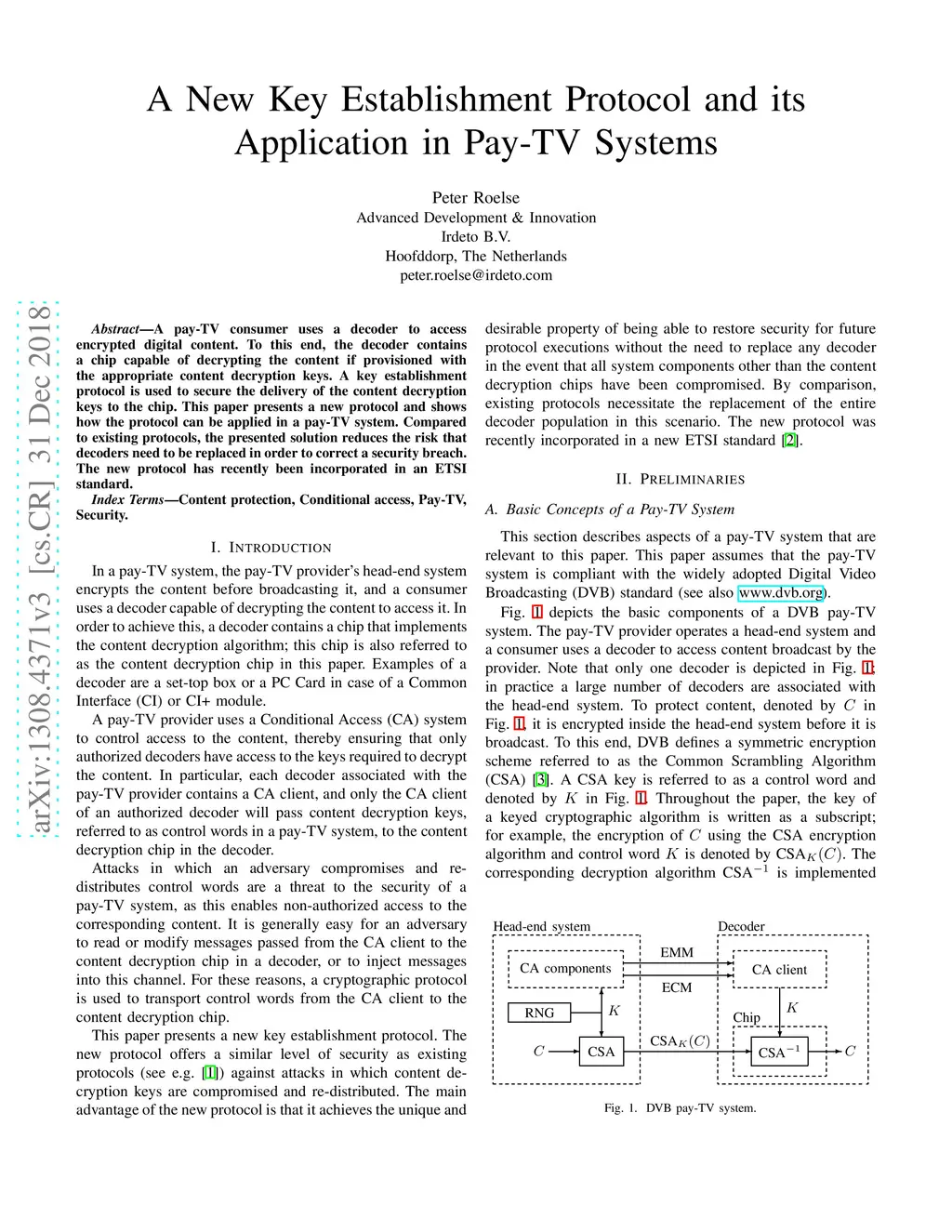
A pay-TV consumer uses a decoder to access encrypted digital content. To this end, a decoder contains a chip capable of decrypting the content. The recently standardized K-LAD key establishment protocol can be used to secure the delivery of content decryption keys to the chip. This paper presents a new key establishment protocol. The paper shows how the new protocol can be applied in a pay-TV system, and provides a comparison of the properties of the new protocol and the K-LAD protocol. In particular, it is shown that the new protocol offers a similar level of security as the K-LAD protocol against attacks in which content decryption keys are compromised and re-distributed. An advantage of the new protocol compared to the K-LAD protocol is that the trusted third party in the new protocol manages a public master key of each decoder instead of a secret master key of each decoder. Compared to K-LAD, this simplifies key management and reduces the level of trust required in the trusted third party. In addition, the new protocol achieves the desirable property that a decoder needs to be revoked only if its chip is compromised. This reduces the risk that the decoder of an honest consumer needs to be revoked to restore system security.
View on arXiv