
A stronger null hypothesis for crossing dependencies
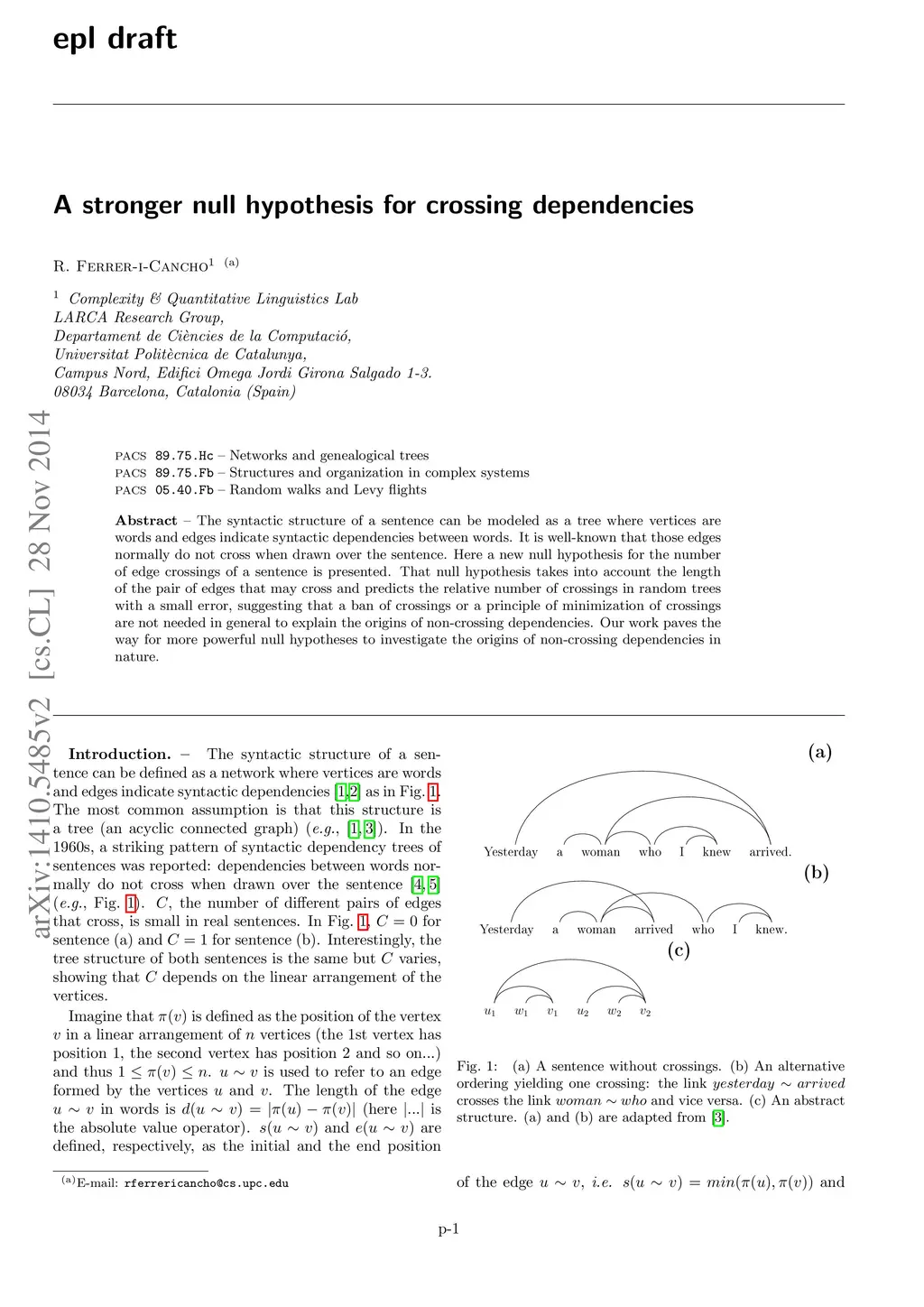
The syntactic structure of a sentence can be modeled as a tree where vertices are words and edges indicate syntactic dependencies between words. It is well-known that those edges normally do not cross when drawn over the sentence. Here a new null hypothesis for the number of edge crossings of a sentence is presented. That null hypothesis takes into account the length of the pair of edges that may cross and predicts the relative number of crossings in random trees with a small error, suggesting that a ban of crossings or a principle of minimization of crossings are not needed in general to explain the origins of non-crossing dependencies. Our work paves the way for more powerful null hypotheses to investigate the origins of non-crossing dependencies in nature.
View on arXiv