
The local convexity of solving systems of quadratic equations
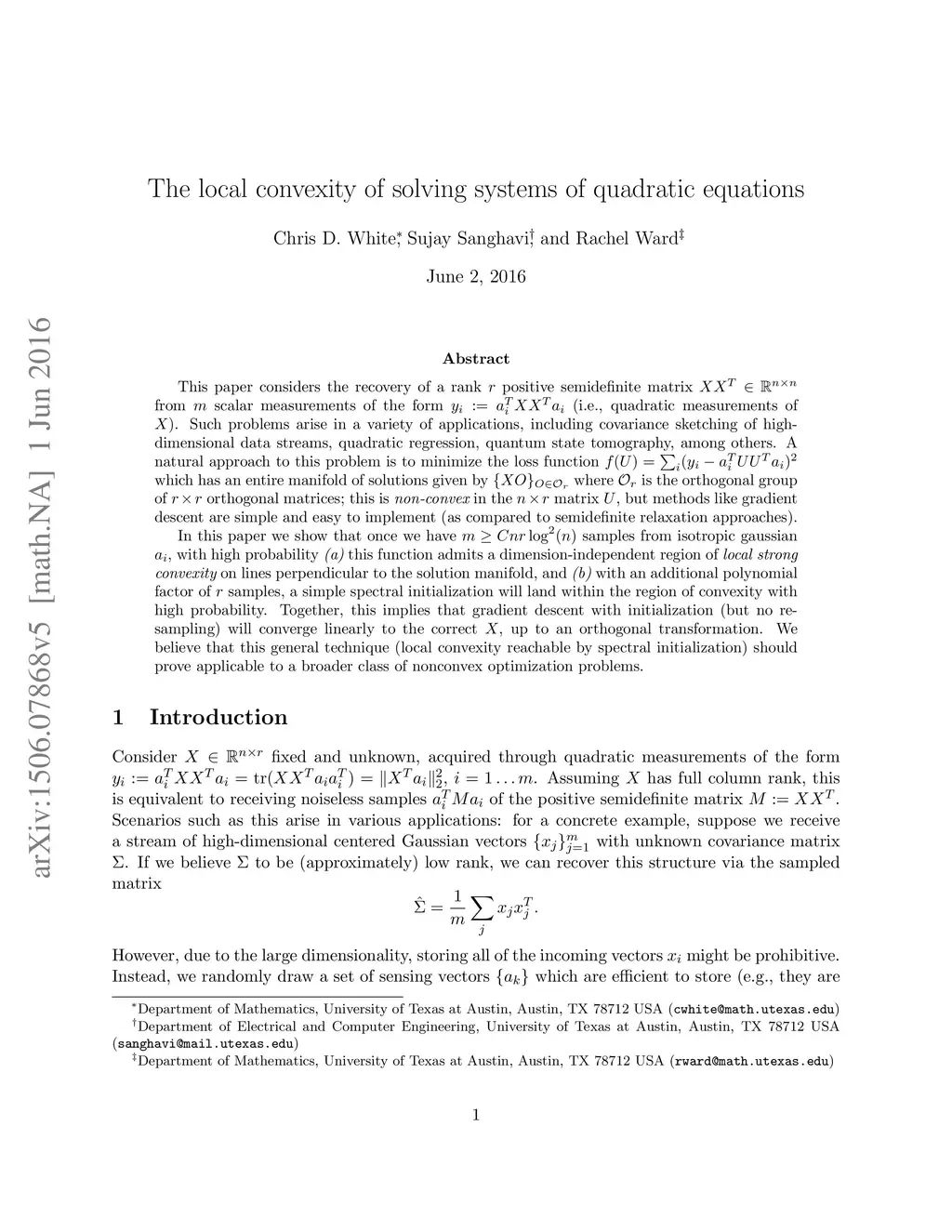
This paper considers the recovery of a rank positive semidefinite matrix from scalar measurements of the form (i.e., quadratic measurements of ). Such problems arise in a variety of applications, including covariance sketching of high-dimensional data streams, quadratic regression, quantum state tomography, among others. A natural approach to this problem is to minimize the loss function which has an entire manifold of solutions given by where is the orthogonal group of orthogonal matrices; this is {\it non-convex} in the matrix , but methods like gradient descent are simple and easy to implement (as compared to semidefinite relaxation approaches). In this paper we show that once we have samples from isotropic gaussian , with high probability {\em (a)} this function admits a dimension-independent region of {\em local strong convexity} on lines perpendicular to the solution manifold, and {\em (b)} with an additional polynomial factor of samples, a simple spectral initialization will land within the region of convexity with high probability. Together, this implies that gradient descent with initialization (but no re-sampling) will converge linearly to the correct , up to an orthogonal transformation. We believe that this general technique (local convexity reachable by spectral initialization) should prove applicable to a broader class of nonconvex optimization problems.
View on arXiv