
Solve-Select-Scale: A Three Step Process For Sparse Signal Estimation
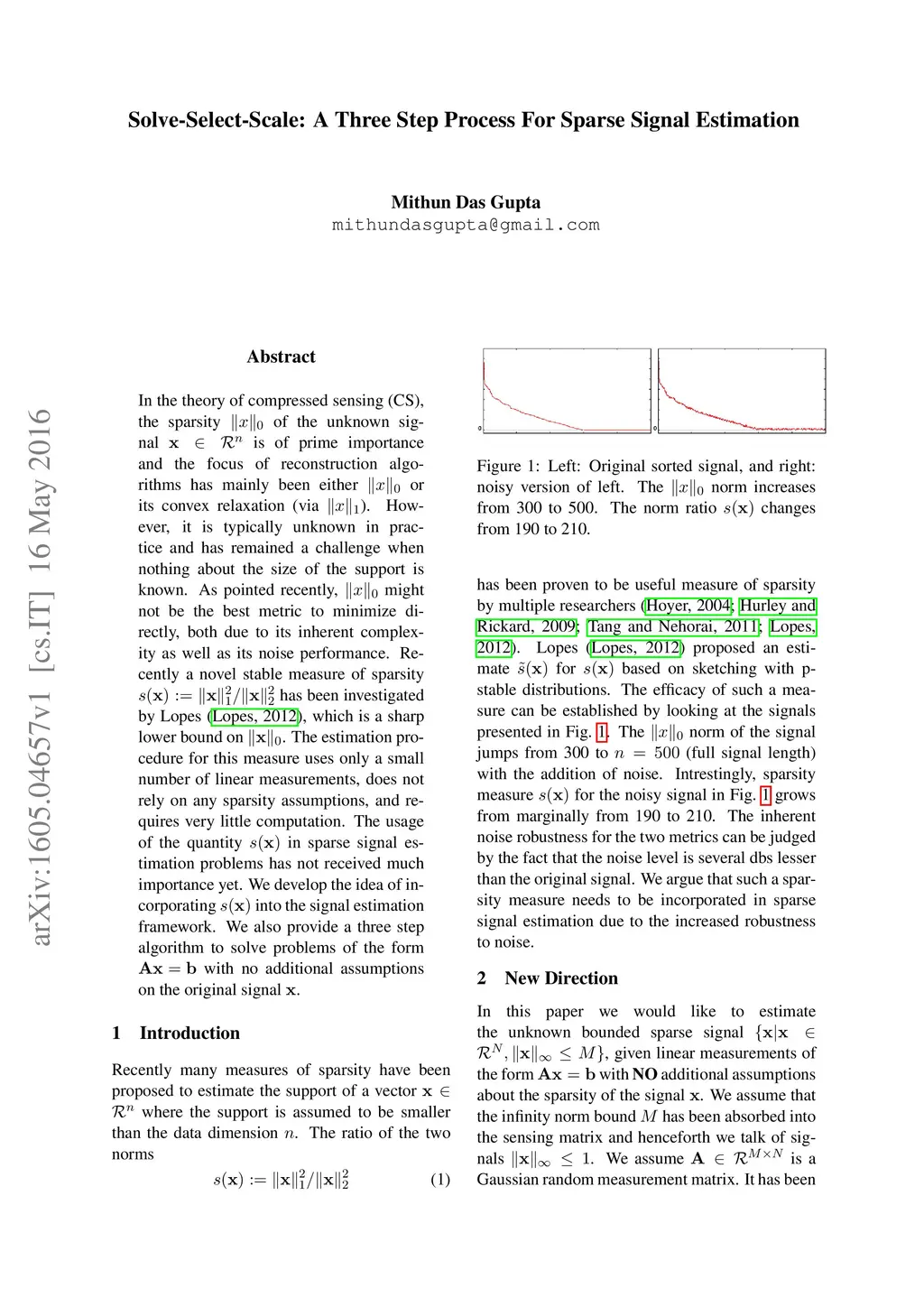
In the theory of compressed sensing (CS), the sparsity of the unknown signal is of prime importance and the focus of reconstruction algorithms has mainly been either or its convex relaxation (via ). However, it is typically unknown in practice and has remained a challenge when nothing about the size of the support is known. As pointed recently, might not be the best metric to minimize directly, both due to its inherent complexity as well as its noise performance. Recently a novel stable measure of sparsity has been investigated by Lopes \cite{Lopes2012}, which is a sharp lower bound on . The estimation procedure for this measure uses only a small number of linear measurements, does not rely on any sparsity assumptions, and requires very little computation. The usage of the quantity in sparse signal estimation problems has not received much importance yet. We develop the idea of incorporating into the signal estimation framework. We also provide a three step algorithm to solve problems of the form with no additional assumptions on the original signal .
View on arXiv