
Popular Matchings with Multiple Partners
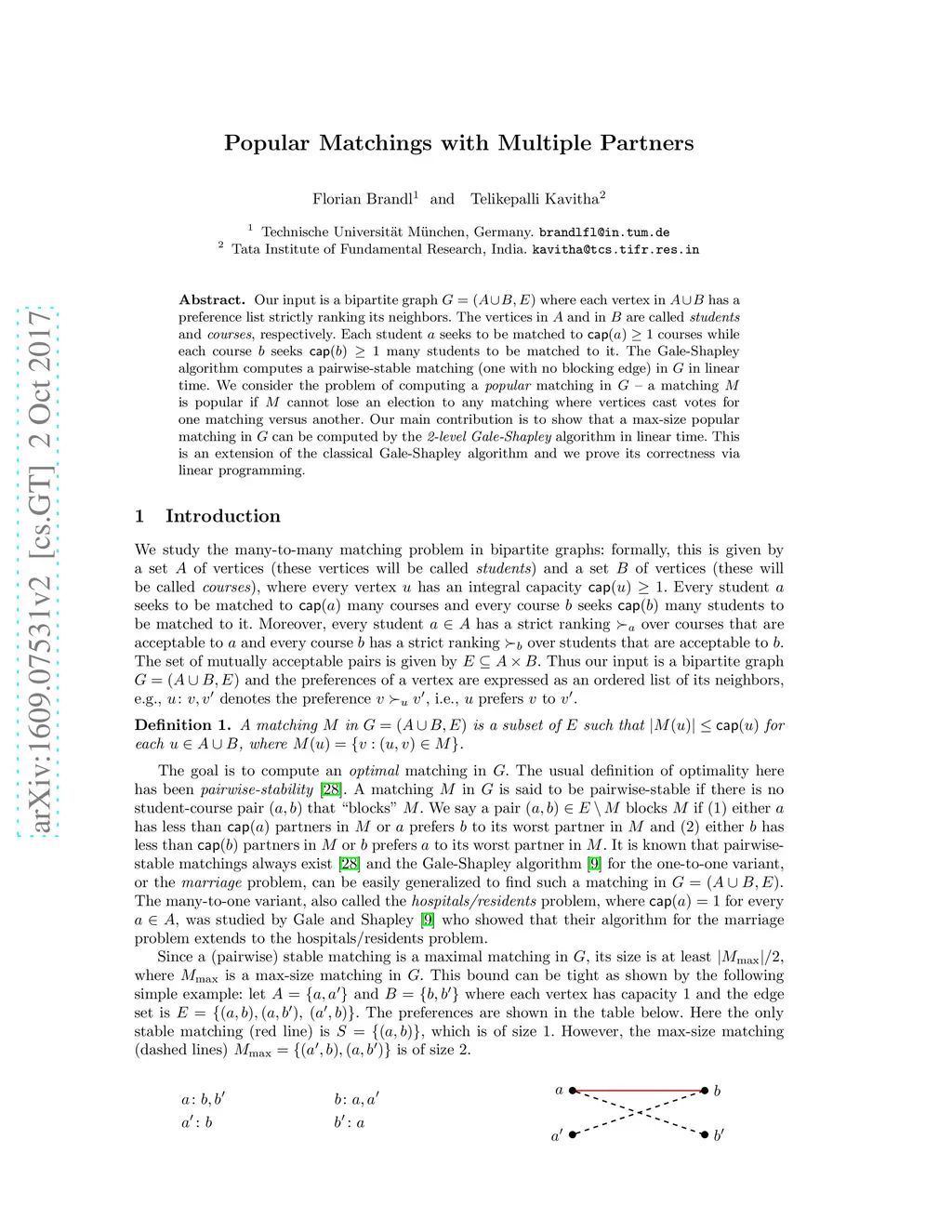
Our input is a bipartite graph where each vertex in has a preference list strictly ranking its neighbors. The vertices in (similarly, in ) are called residents (resp., hospitals): each resident seeks to be matched to a hospital while each hospital seeks many residents to be matched to it. The Gale-Shapley algorithm computes a stable matching in in linear time. We consider the problem of computing a popular matching in - a matching is popular if cannot lose an election to any other matching where vertices cast votes for one matching versus another. Our main contribution is to show that a max-size popular matching in can be computed by the 2-level Gale-Shapley algorithm in linear time. This is a simple extension of the classical Gale-Shapley algorithm and we prove its correctness via linear programming.
View on arXiv