
The Advantage of Truncated Permutations
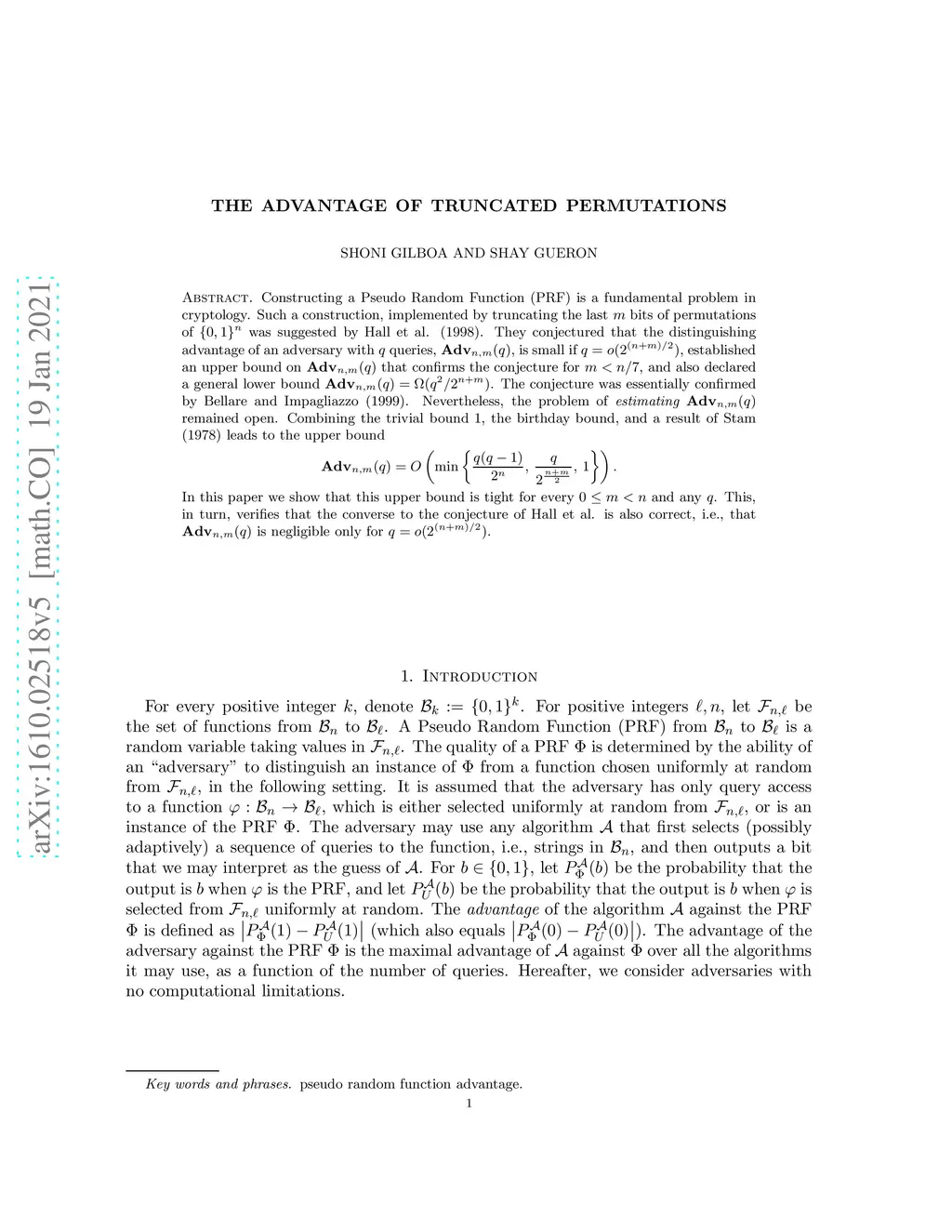
Let be non-negative integers. An oracle chooses a permutation of uniformly at random. When queried with an -bit string , it truncates the last bits of , and returns the remaining first bits. Such truncated random permutations were suggested by Hall et al., in 1998, as a construction of a Pseudo Random Function. They conjectured that the distinguishing advantage of this PRF, given a budget of queries, , is small if . They established a general upper bound on , which confirms the conjecture only for . The conjecture was essentialy confirmed by Bellare and Impagliazzo in 1999. Nevertheless, the problem of estimating remained open. Combining the trivial bound , the birthday bound, and a result that Stam had published much earlier in 1978, in a different context, leads to the following upper bound: This paper settles the open problem by showing that this bound is tight.
View on arXiv