
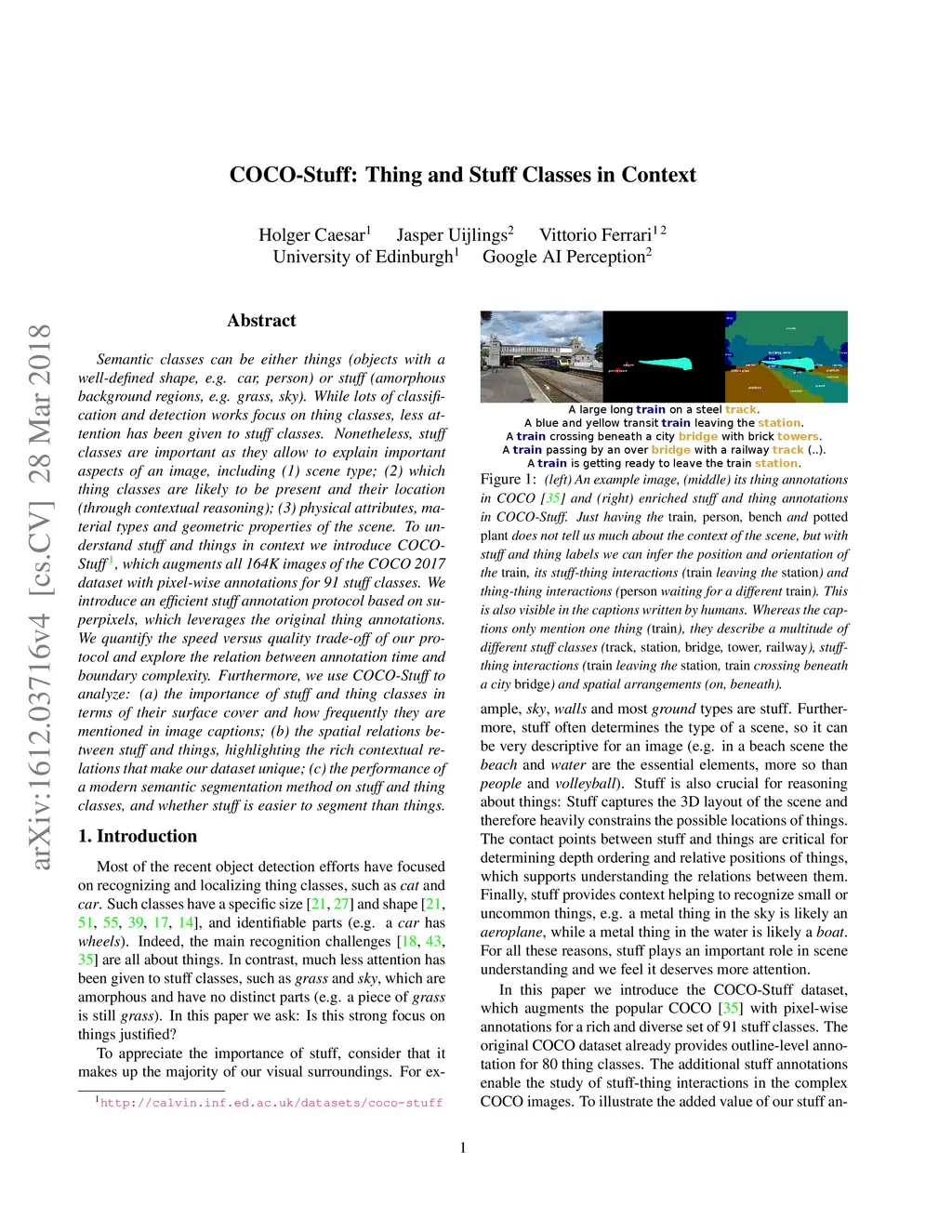
Semantic classes can be either things (objects with a well-defined shape, e.g. car, person) or stuff (amorphous background regions, e.g. grass, sky). While lots of classification and detection works focus on thing classes, less attention has been given to stuff classes. Nonetheless, stuff classes are important as they allow to explain important aspects of an image, including (1) scene type; (2) which thing classes are likely to be present and their location (determined through contextual reasoning); (3) physical attributes, material types and geometric properties of the scene. To understand stuff and things in context we annotate 10,000 images of the COCO dataset with a broad range of stuff classes, using a specialized stuff annotation protocol allowing us to efficiently label each pixel. On this dataset, we analyze several aspects: (a) the importance of stuff and thing classes in terms of their surface cover and how frequently they are mentioned in image captions; (b) the importance of several visual criteria to discriminate stuff and thing classes; (c) we study the spatial relations between stuff and things, highlighting the rich contextual relations that make our dataset unique. Furthermore, we show experimentally how modern semantic segmentation methods perform on stuff and thing classes and answer the question whether stuff is easier to segment than things. We release our new dataset and the trained models online, hopefully promoting further research on stuff and stuff-thing contextual relations.
View on arXiv