
4-DoF Tracking for Robot Fine Manipulation Tasks
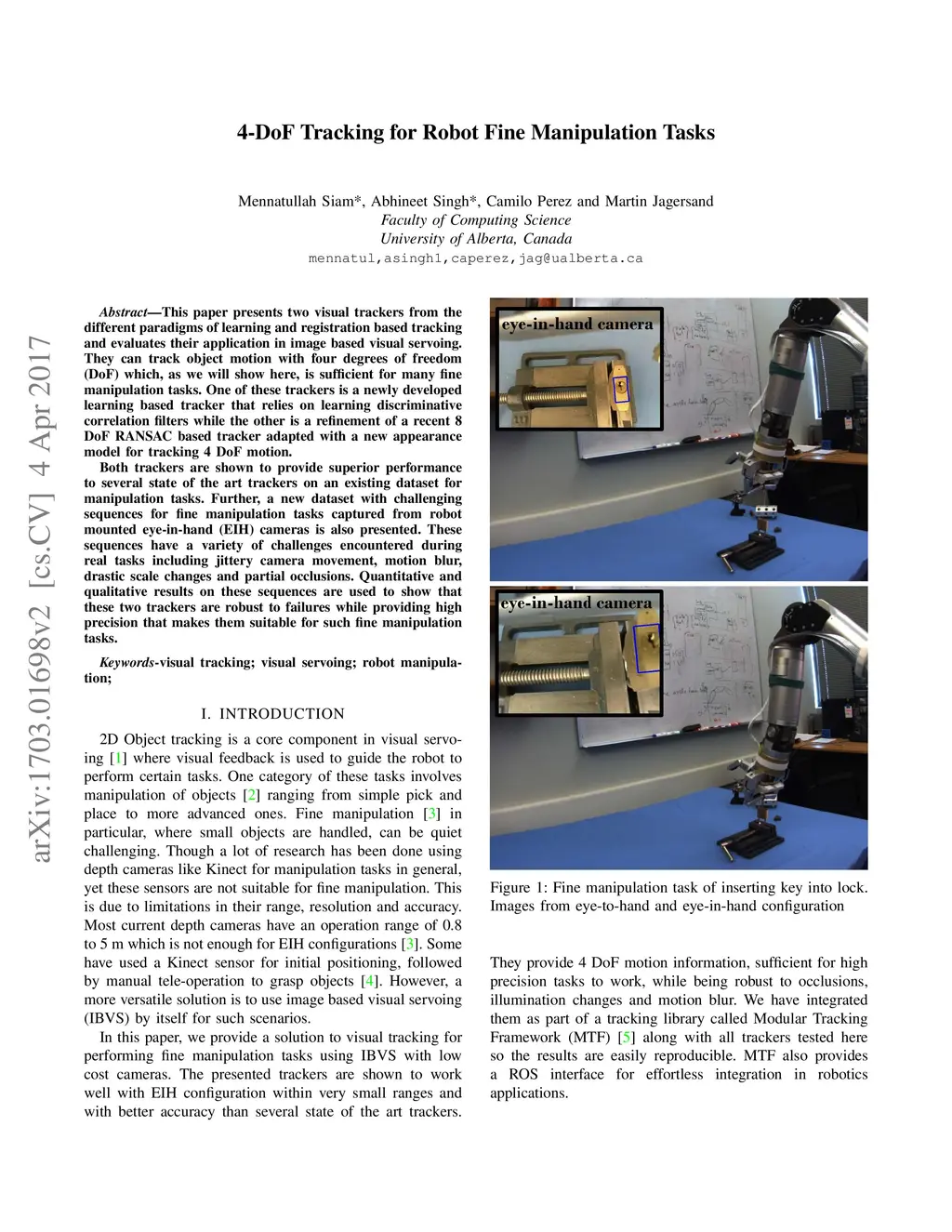
This paper presents two visual trackers from the different paradigms of learning and registration based tracking and evaluates their application in image based visual servoing. They can track object motion with four degrees of freedom (DOF) which, as we will show here, is sufficient for many fine manipulation tasks. One of these is a newly developed learning based tracker that relies on learning discriminative correlation filters while the other is a refinement of a recent 8 DoF RANSAC based tracker adapted with a new appearance model for 4 DoF motion. Both trackers are shown to have superior performance to other state of the art trackers on an existing dataset for manipulation tasks. Further, a new dataset with challenging sequences for fine manipulation tasks captured from the robot mounted eye-in-hand (EIH) cameras is also presented. These sequences have a variety of challenges encountered during real tasks including jittery camera movement, motion blur, drastic scale changes and partial occlusions. Quantitative and qualitative results of both trackers in comparison to eight recent state of the art trackers are shown on these sequences. It proves that these two trackers are robust to failures while maintaining high precision that makes them suitable for such fine manipulation tasks.
View on arXiv