
Recognition in-the-Tail: Training Detectors for Unusual Pedestrians with
Synthetic Imposters
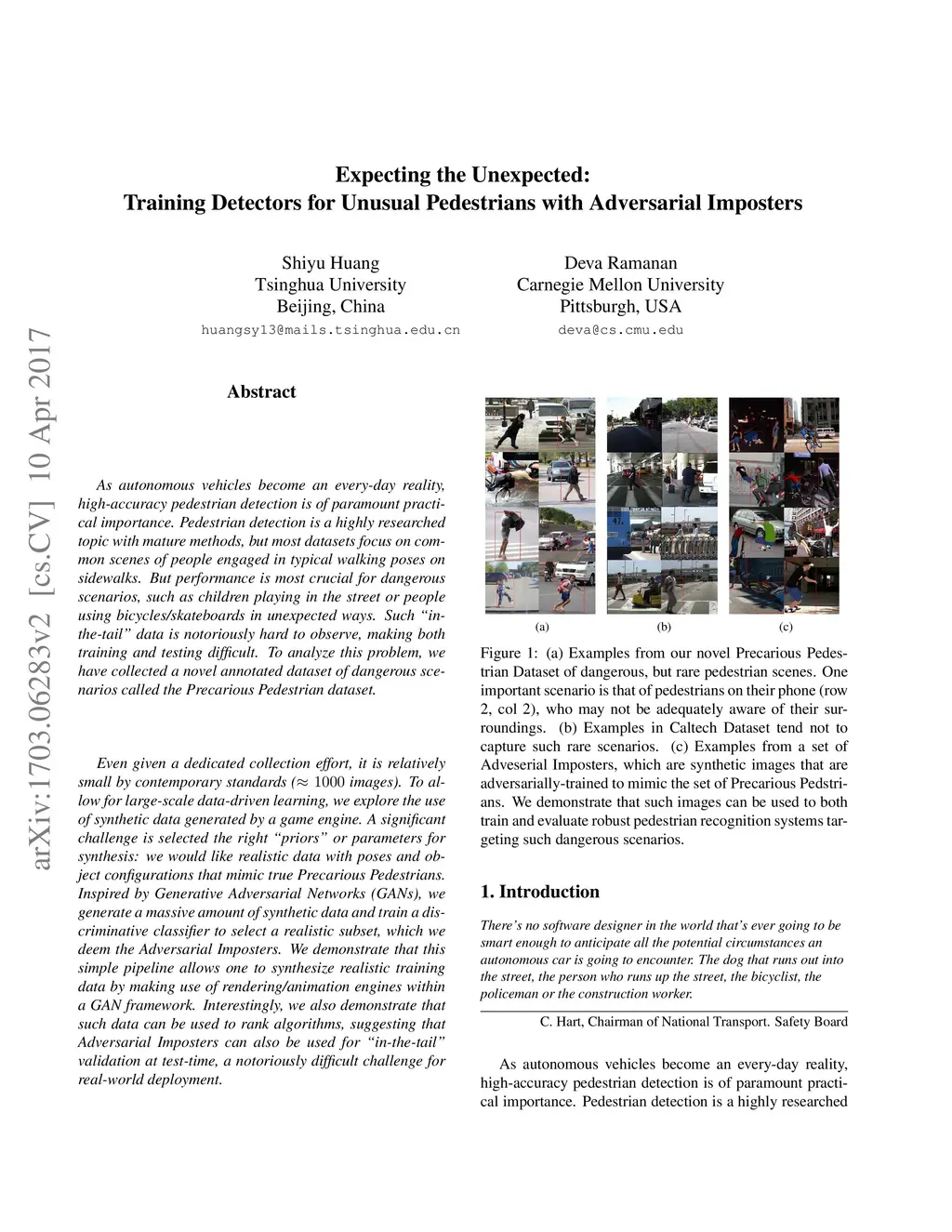
As autonomous vehicles become an every-day reality, high-accuracy pedestrian detection is of paramount practical importance. Pedestrian detection is a highly researched topic with mature methods, but most datasets focus on common scenes of people engaged in typical walking poses on sidewalks. But performance is most crucial for dangerous scenarios, such as children playing in the street or people using bicycles/skateboards in unexpected ways. Such "in-the-tail" data is notoriously hard to observe, making both training and testing difficult. To analyze this problem, we have collected a novel annotated dataset of dangerous scenarios called the Precarious Pedestrian dataset. Even given a dedicated collection effort, it is relatively small by contemporary standards (around 1000 images). To explore large-scale data-driven learning, we explore the use of synthetic data generated by a game engine. A significant challenge is selected the right "priors" or parameters for synthesis: we would like realistic data with realistic poses and object configurations. Inspired by Generative Adversarial Networks, we generate a massive amount of synthetic data and train a discriminative classifier to select a realistic subset, which we deem Synthetic Imposters. We demonstrate that this pipeline allows one to generate realistic training data by making use of rendering/animation engines. Interestingly, we also demonstrate that such data can be used to rank algorithms, suggesting that Synthetic Imposters can also be used for "in-the-tail" validation at test-time, a notoriously difficult challenge for real-world deployment.
View on arXiv