
Toward Open Set Face Recognition
- CVBM
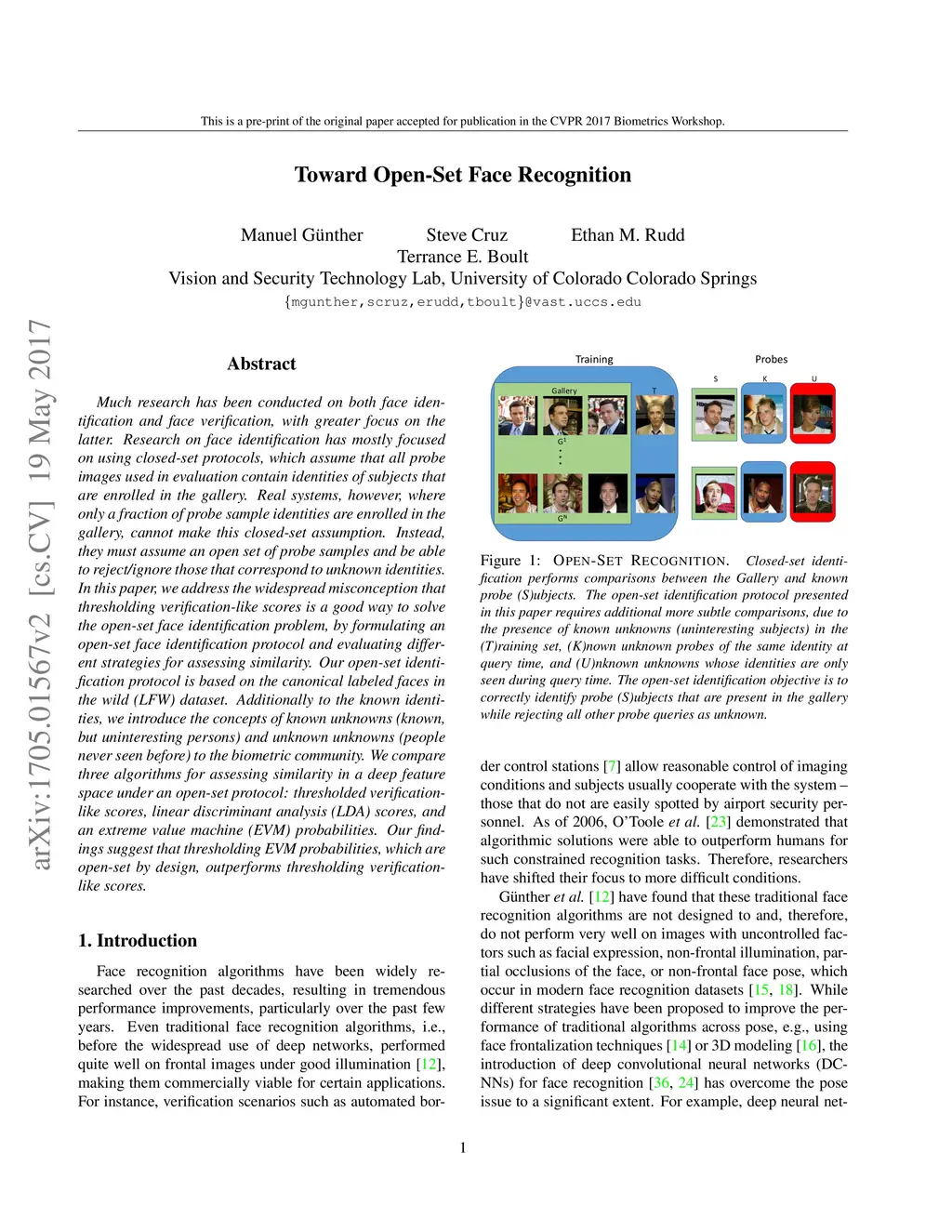
Much research has been conducted on both face identification and face verification problems, with greater focus on the latter. Research on face identification has mostly focused on using closed-set protocols, which assume that all probe images used in evaluation contain identities of subjects that are enrolled in the gallery. Real systems, however, where only a fraction of probe sample identities are enrolled in the gallery, cannot make this closed-set assumption. Instead, they must assume an open set of probe samples and be able to reject/ignore those that correspond to unknown identities. In this paper, we address the widespread misconception that thresholding verification-like scores is sufficient to solve the open-set face identification problem, by formulating an open-set face identification protocol and evaluating different strategies for assessing similarity. Our open-set identification protocol is based on the canonical labeled faces in the wild (LFW) dataset. We compare three algorithms for assessing similarity in a deep feature space under an open-set protocol: thresholded verification-like scores, linear discriminant analysis (LDA) scores, and an extreme value machine (EVM) output probabilities. Our findings suggest that thresholding similarity measures that are open-set by design outperforms verification-like score level thresholding.
View on arXiv