
Interoperable Convergence of Storage, Networking and Computation
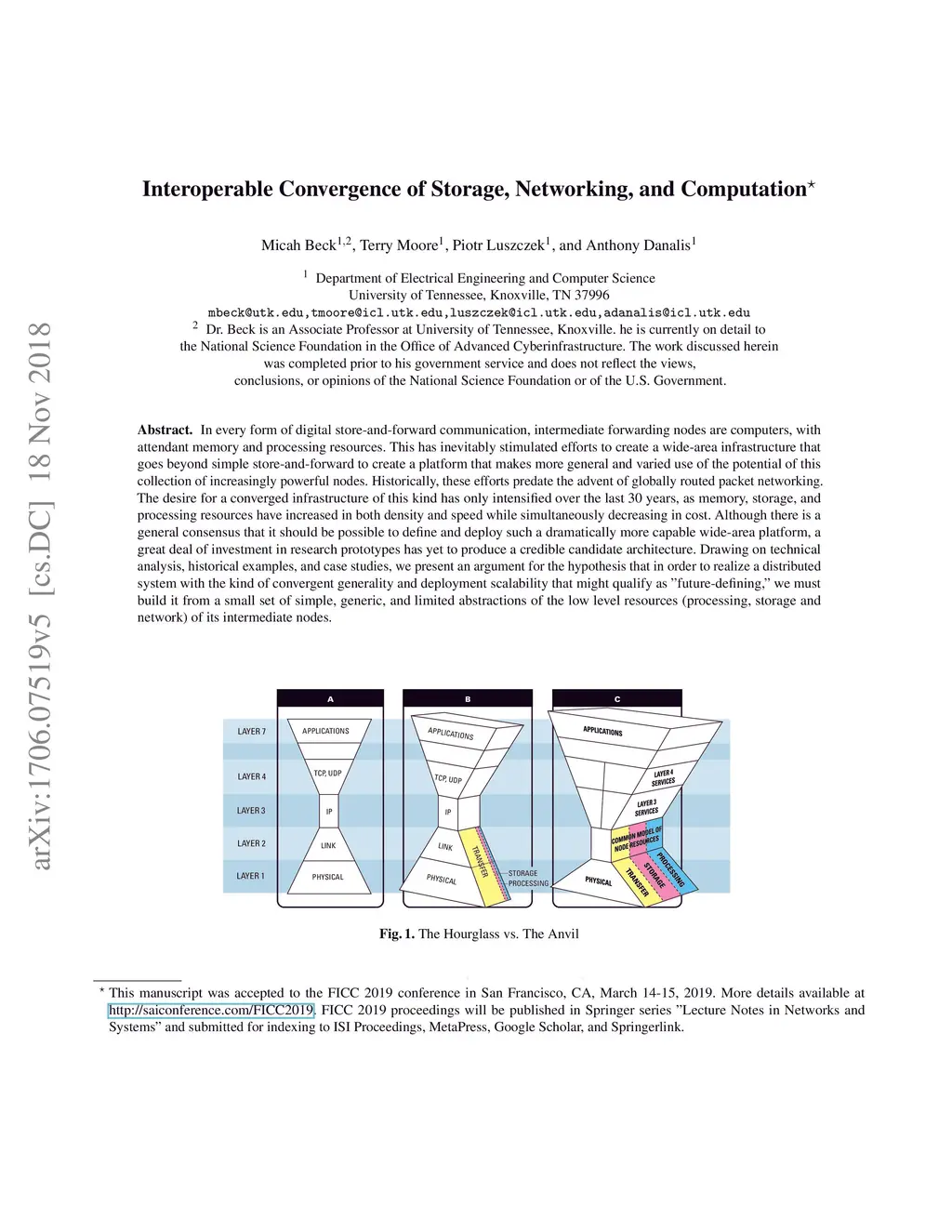
In every form of digital store-and-forward communication, intermediate forwarding nodes are computers, with attendant memory and processing resources. This has inevitably given rise to efforts to create a wide area infrastructure that goes beyond simple store and forward, a facility that makes more general and varied use of the potential of this collection of increasingly powerful nodes. Historically, efforts in this direction predate the advent of globally routed packet networking. The desire for a converged infrastructure of this kind has only intensified over the last 30 years, as memory, storage and processing resources have both increased in density and speed and decreased in cost. Although there seems to be a general consensus that it should be possible to define and deploy such a dramatically more capable wide area facility, a great deal of investment in research prototypes has yet to produce a credible candidate architecture. Drawing on technical analysis, historical examples, and case studies, we present a argument for the hypothesis that in order to realize a distributed system with the kind of convergent generality and deployment scalability that might qualify as "future-defining," we must build it up from a small set of simple, generic, and limited abstractions of the low level processing, storage and network resources of its intermediate nodes.
View on arXiv