
Storage, Communication, and Load Balancing Trade-off in Distributed
Cache Networks
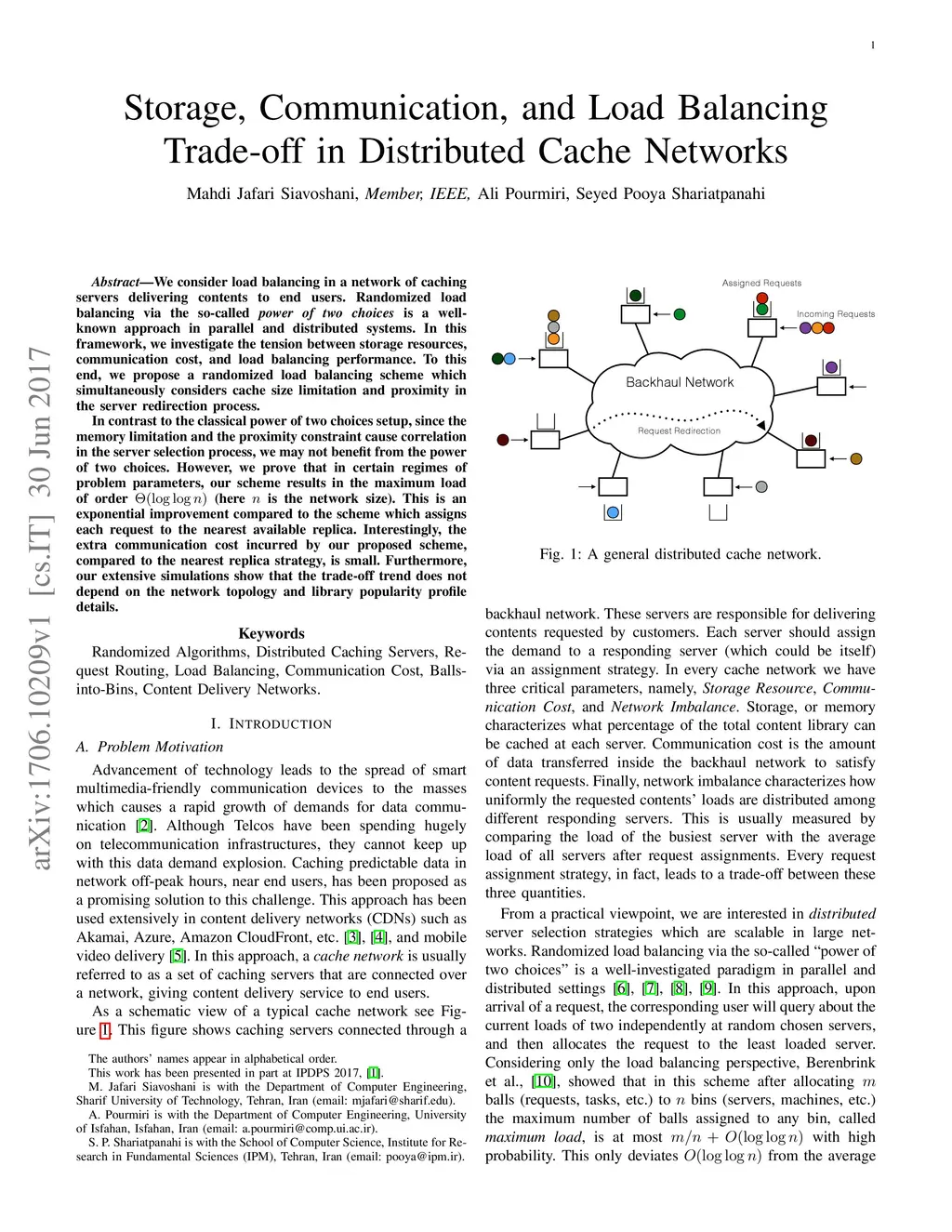
We consider load balancing in a network of caching servers delivering contents to end users. Randomized load balancing via the so-called power of two choices is a well-known approach in parallel and distributed systems. In this framework, we investigate the tension between storage resources, communication cost, and load balancing performance. To this end, we propose a randomized load balancing scheme which simultaneously considers cache size limitation and proximity in the server redirection process. In contrast to the classical power of two choices setup, since the memory limitation and the proximity constraint cause correlation in the server selection process, we may not benefit from the power of two choices. However, we prove that in certain regimes of problem parameters, our scheme results in the maximum load of order (here is the network size). This is an exponential improvement compared to the scheme which assigns each request to the nearest available replica. Interestingly, the extra communication cost incurred by our proposed scheme, compared to the nearest replica strategy, is small. Furthermore, our extensive simulations show that the trade-off trend does not depend on the network topology and library popularity profile details.
View on arXiv