
Maximum Classifier Discrepancy for Unsupervised Domain Adaptation
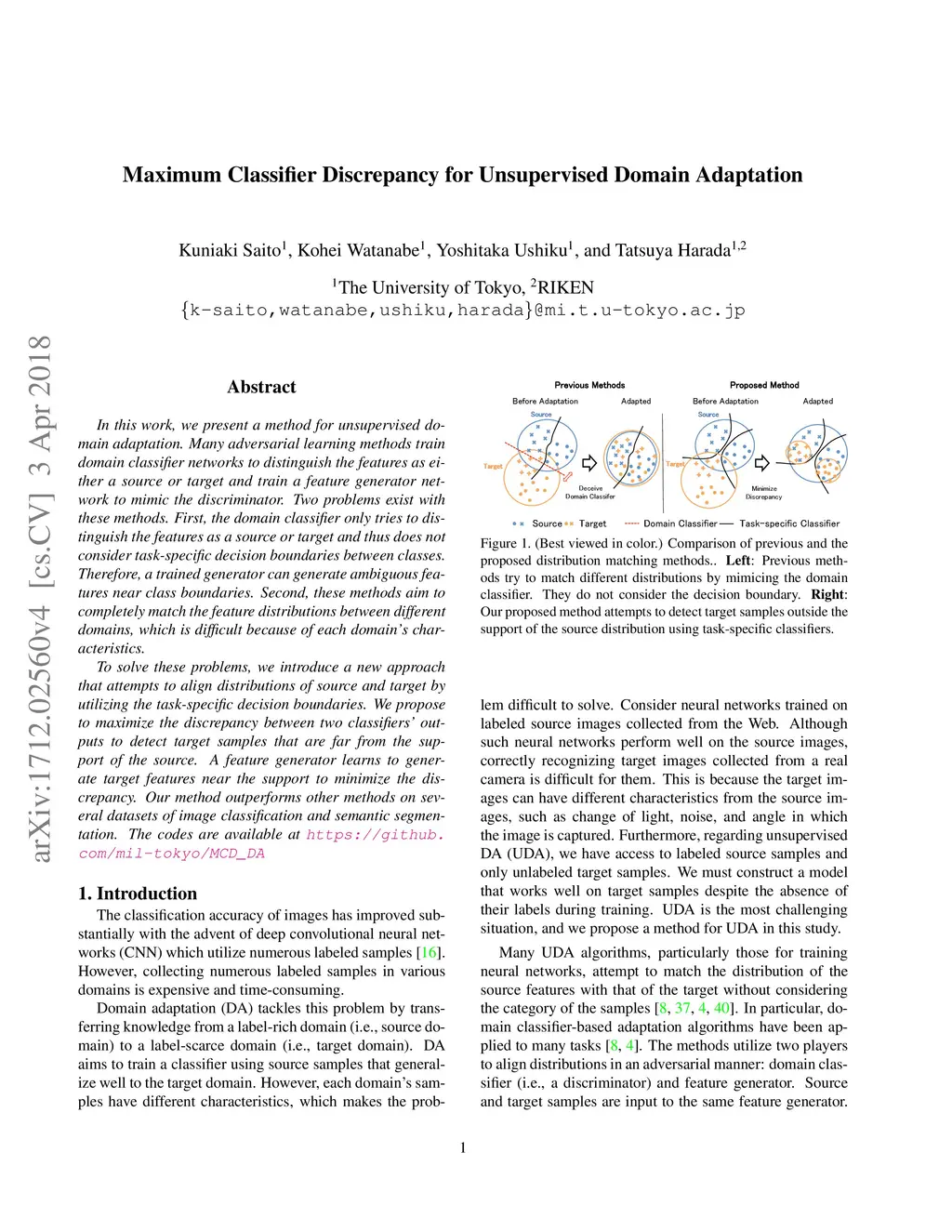
In this work, we present a method for unsupervised domain adaptation (UDA), where we aim to transfer knowledge from a label-rich domain (i.e., a source domain) to an unlabeled domain (i.e., a target domain). Many adversarial learning methods have been proposed for this task. These methods train domain classifier networks (i.e., a discriminator) to discriminate distinguish the features as either a source or target and train a feature generator network to mimic the discriminator.However, the domain classifier only tries to distinguish the features as a source or target and thus does not consider task-specific decision boundaries between classes. Therefore, a trained generator can generate ambiguous features near class boundaries. To solve the problem, we propose a new approach that attempts to align distributions of source and target by utilizing the task-specific decision boundaries. We propose to utilize task-specific classifiers as discriminators that try to detect target samples that are far from the support of the source. A feature generator learns to generate target features inside the support to fool the classifiers. Since the generator uses feedback from task-specific classifiers, it avoids generating target features near class boundaries. Our method outperforms other methods on several datasets of image classification and semantic segmentation.
View on arXiv