
Learning Discriminative Features with Multiple Granularities for Person
Re-Identification
- OOD
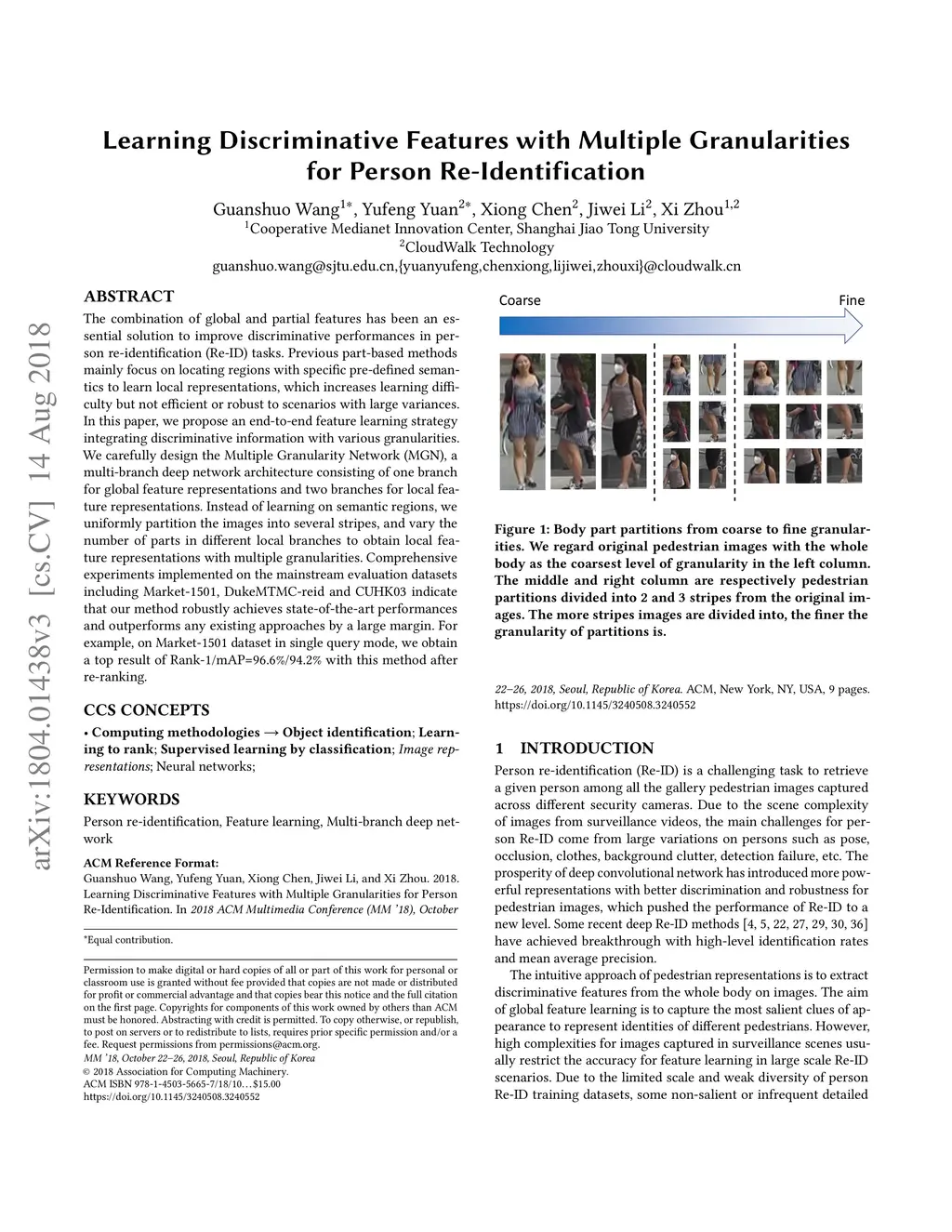
The combination of global and partial features has been an essential solution to improve discriminative performances in person re-identification (Re-ID) tasks. Previous part-based methods mainly focus on locating regions with specific pre-defined semantics to learn local representations, which increases learning difficulty but not efficient or robust to scenarios with large variances. In this paper, we propose an end-to-end feature learning strategy integrating discriminative information with various granularities. We carefully design the Multiple Granularity Network (MGN), a multi-branch deep network architecture consisting of one branch for global feature representations and two branches for local feature representations. Instead of learning on semantic regions, we uniformly partition the images into several stripes, and vary the number of parts in different local branches to obtain local feature representations with multiple granularities. Comprehensive experiments implemented on the mainstream evaluation datasets including Market-1501, DukeMTMC-reid and CUHK03 indicate that our method has robustly achieved state-of-the-art performances and outperformed any existing approaches by a large margin. For example, on Market-1501 dataset in single query mode, we achieve a state-of-the-art result of Rank-1/mAP=96.6%/94.2% after re-ranking.
View on arXiv