
Intractable Likelihood Regression for Covariate Shift by Kernel Mean
Embedding
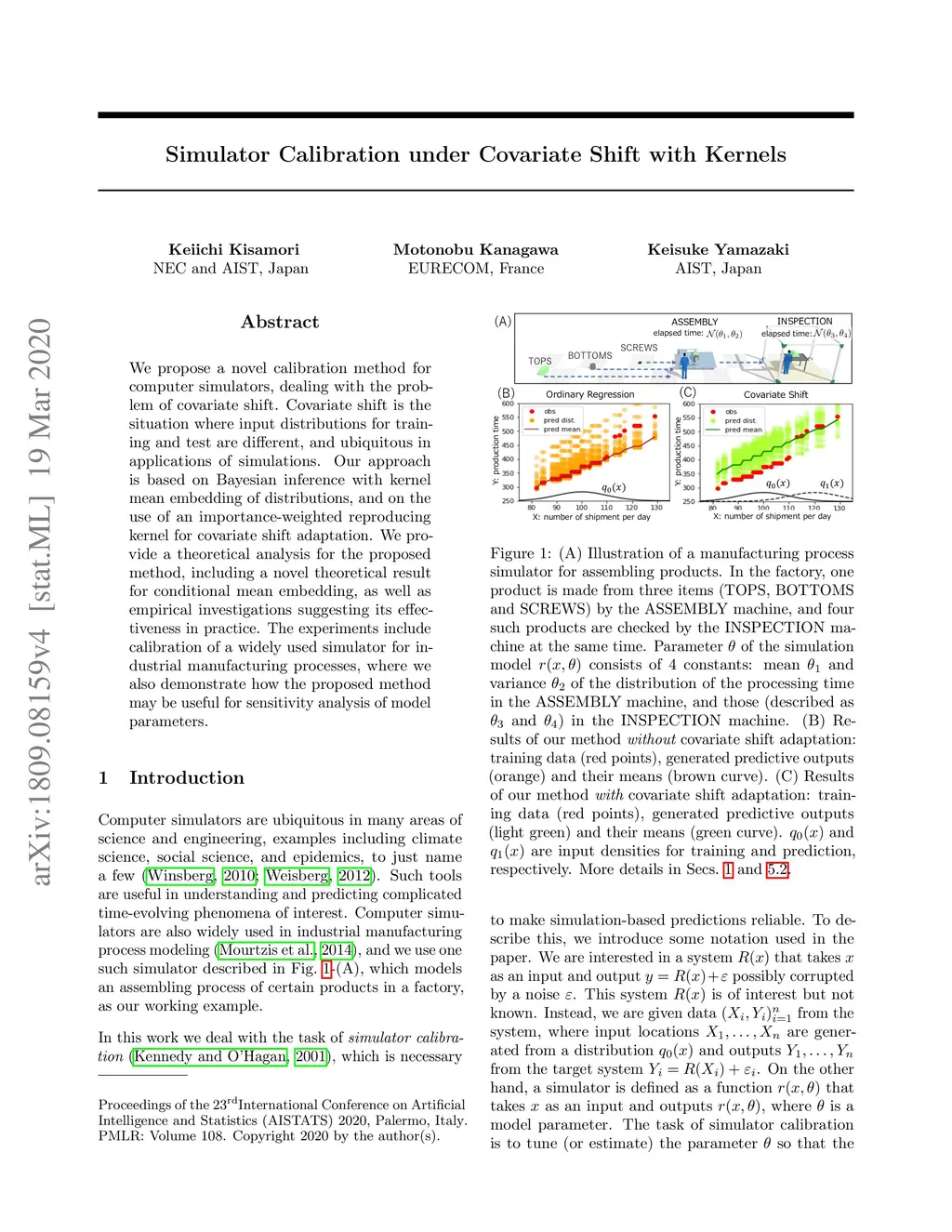
In many fields of social and industrial sciences, simulation is crucial in comprehending a target system. A major task in simulation is the estimation of optimal parameters to express the observed data need to directly elucidate the properties of the target system as a modeling based on the expert's domain knowledge. However, skilled human experts struggle to obtain the desired parameters. Data assimilation therefore becomes an unavoidable task to reduce the cost of simulator optimization. Another necessary task is extrapolation; in many practical cases, predictions based on simulation results will be often outside of the dominant range of a given data area, and this is referred to as the covariate shift. This paper focuses on a regression problem with covariate shift. While the parameter estimation for the covariate shift has been studied thoroughly in parametric and nonparametric settings, conventional statistical methods of parameter searching are not applicable in the data assimilation of the simulation owing to the properties of the likelihood function: intractable or nondifferentiable. Hence, we propose a novel framework of Bayesian inference based on kernel mean embedding. This framework allows for predictions in covariate shift situations, and its effectiveness is evaluated in both synthetic numerical experiments and a widely used production simulator reproducing real-world manufacturing factories.
View on arXiv