
FaceForensics++: Learning to Detect Manipulated Facial Images
- CVBM
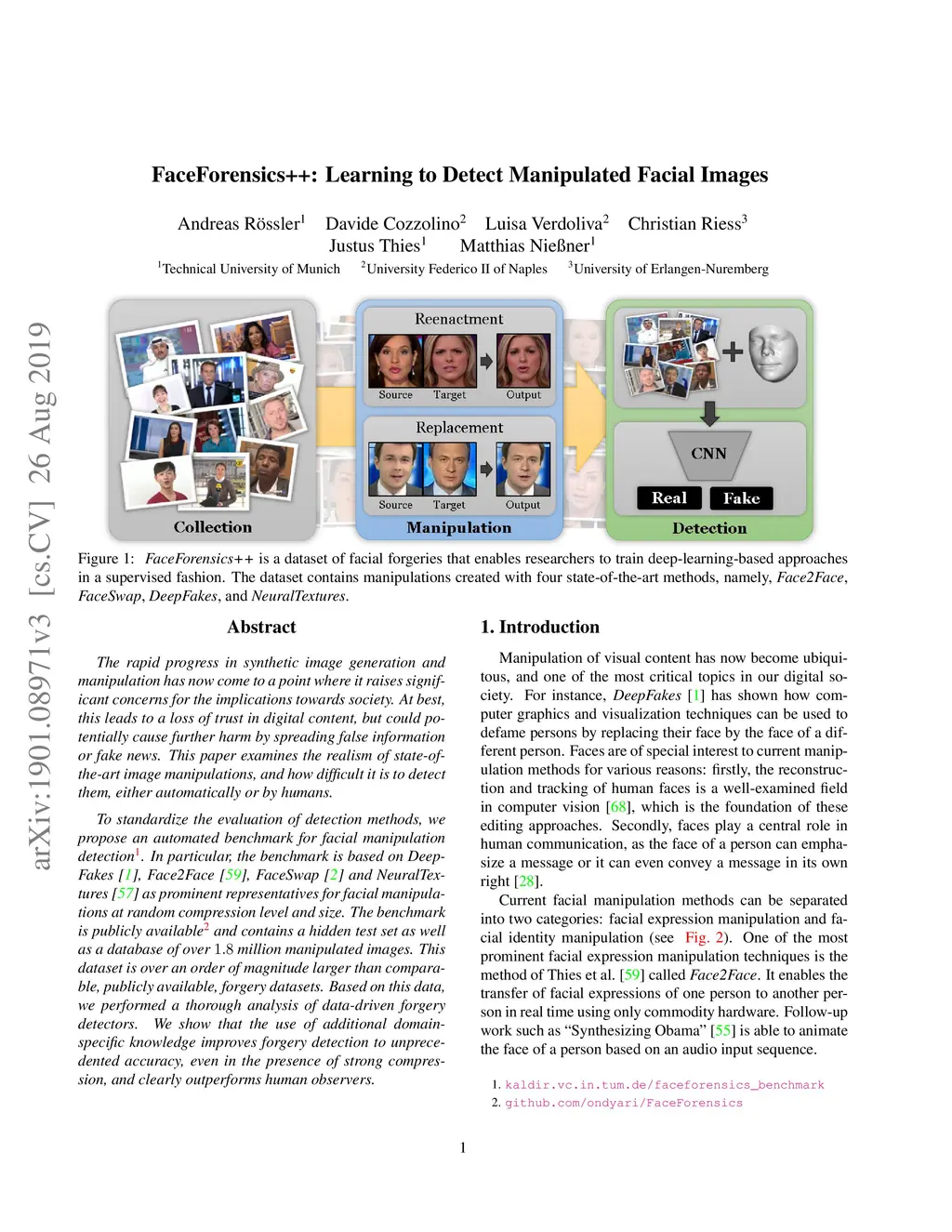
The rapid progress in synthetic image generation and manipulation has now come to a point where it raises significant concerns on the implication on the society. At best, this leads to a loss of trust in digital content, but it might even cause further harm by spreading false information and the creation of fake news. This paper examines the realism of state-of-the-art image manipulations, and how difficult it is to detect them - either automatically or by humans. To standardize the evaluation of detection methods, we propose an automated benchmark for facial manipulation detection. In particular, the benchmark is based on DeepFakes, Face2Face, and FaceSwap as prominent representatives for facial manipulations at random compression level and size. The benchmark is publicly available and contains a hidden test set as well as a database of about 1.5 million manipulated images. Thus, this database is at least an order of magnitude larger than comparable, publicly available, forgery datasets. Based on this data, we performed a thorough analysis of data-driven forgery detectors. We show that the use of additional domain-specific knowledge improves forgery detection to unprecedented accuracy, even in the presence of strong compression and clearly outperforms human observers.
View on arXiv