
Pushing the Boundaries of Asymptotic Optimality for Sampling-based
Roadmaps In Motion And Task Planning
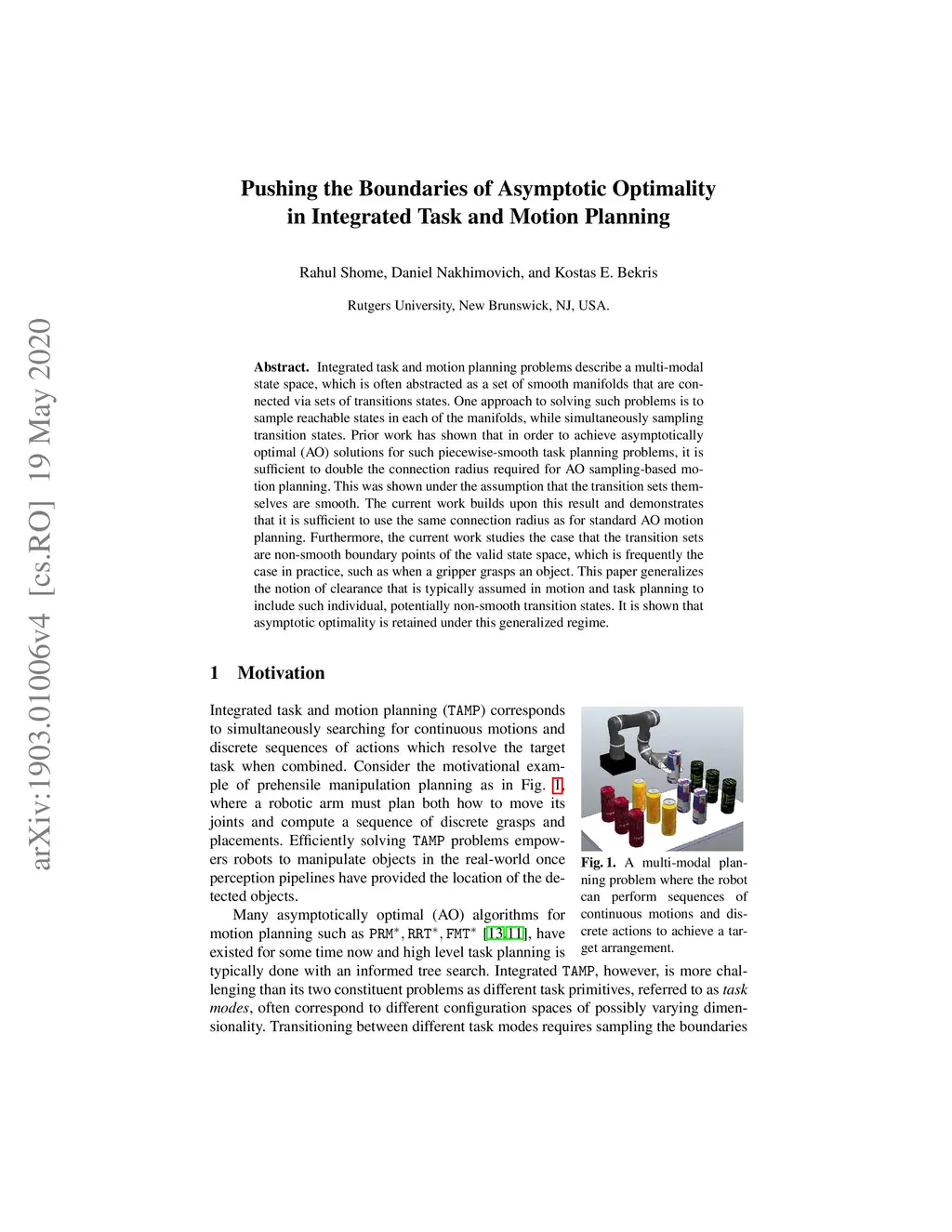
Sampling-based roadmaps have been popular methods for robot motion and task planning, given their generality and effectiveness in high-dimensional configuration spaces (C-spaces). Following advances in random geometric graphs, a seminal analysis result argued the conditions for asymptotic optimality of these approaches. In particular, a connection radius for each new C-space sample needs to be in the order of $ \gamma (\log n / n)^{1/d} $, where is the existing number of roadmap nodes and is the dimensionality of the C-space. This prior analysis, as well as subsequent efforts, also specified a sufficient lower bound for the constant for asymptotic optimality. All of these results assumed that for a finite number of samples there is a path with positive clearance from obstacles. Nevertheless, manipulation task planning requires solving problems were the start and the goal lie on the boundary of the configuration space. The current work builds on previous work, to: a) obtain an estimate of in terms of a bound on the dispersion of the samples; and b) propose the modifications necessary to make asymptotic optimality hold when the start and goal lie on the boundary of the C-space under certain assumptions regarding the boundary. The last point generalizes these properties to manipulation task planning and reduces the method's requirements for a connection radius that achieves asymptotic optimality in this domain as well as the assumptions regarding the boundary's smoothness relative to prior work.
View on arXiv