
Training neural networks to mimic the brain improves object recognition
performance
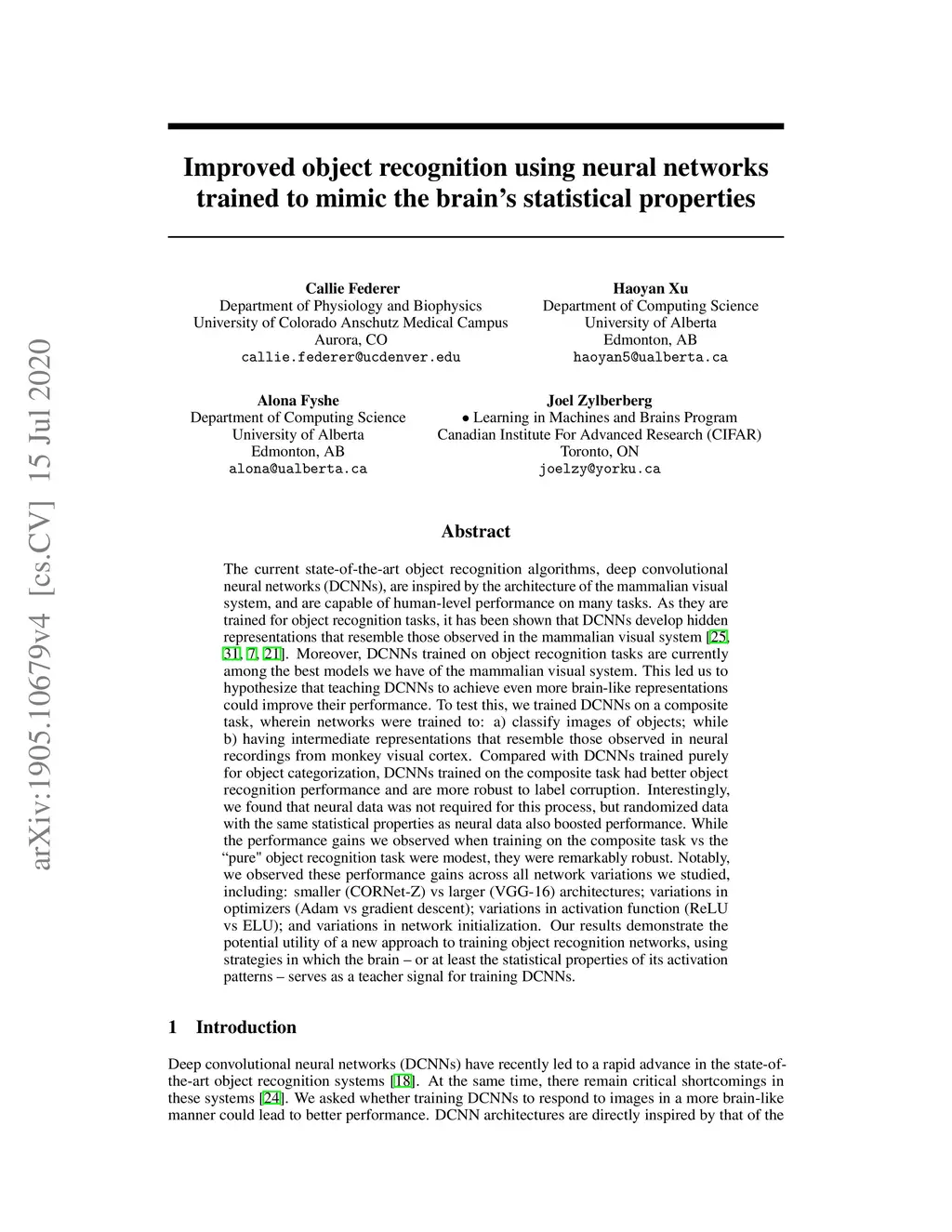
The current state-of-the-art object recognition algorithms, deep convolutional neural networks (DCNNs), are inspired by the architecture of the mammalian visual system, and capable of human-level performance on many tasks. However, even these algorithms make errors. As DCNNs train on object recognition tasks, they develop representations in their hidden layers that become more similar to those observed in the mammalian brains. Moreover, DCNNs trained on object recognition tasks are currently among the best models we have of the mammalian visual system. This led us to hypothesize that teaching DCNNs to achieve even more brain-like representations could improve their performance. To test this, we trained DCNNs on a composite task, wherein networks were trained to: a) classify images of objects; while b) having intermediate representations that resemble those observed in neural recordings from monkey visual cortex. Compared with DCNNs trained purely for object categorization, DCNNs trained on the composite task had better object recognition performance, make more reasonable errors and are more robust to label corruption. Our results outline a new way to train object recognition networks, using strategies in which the brain serves as a teacher signal for training DCNNs.
View on arXiv