
Learning Instance Occlusion for Panoptic Segmentation
- ISeg
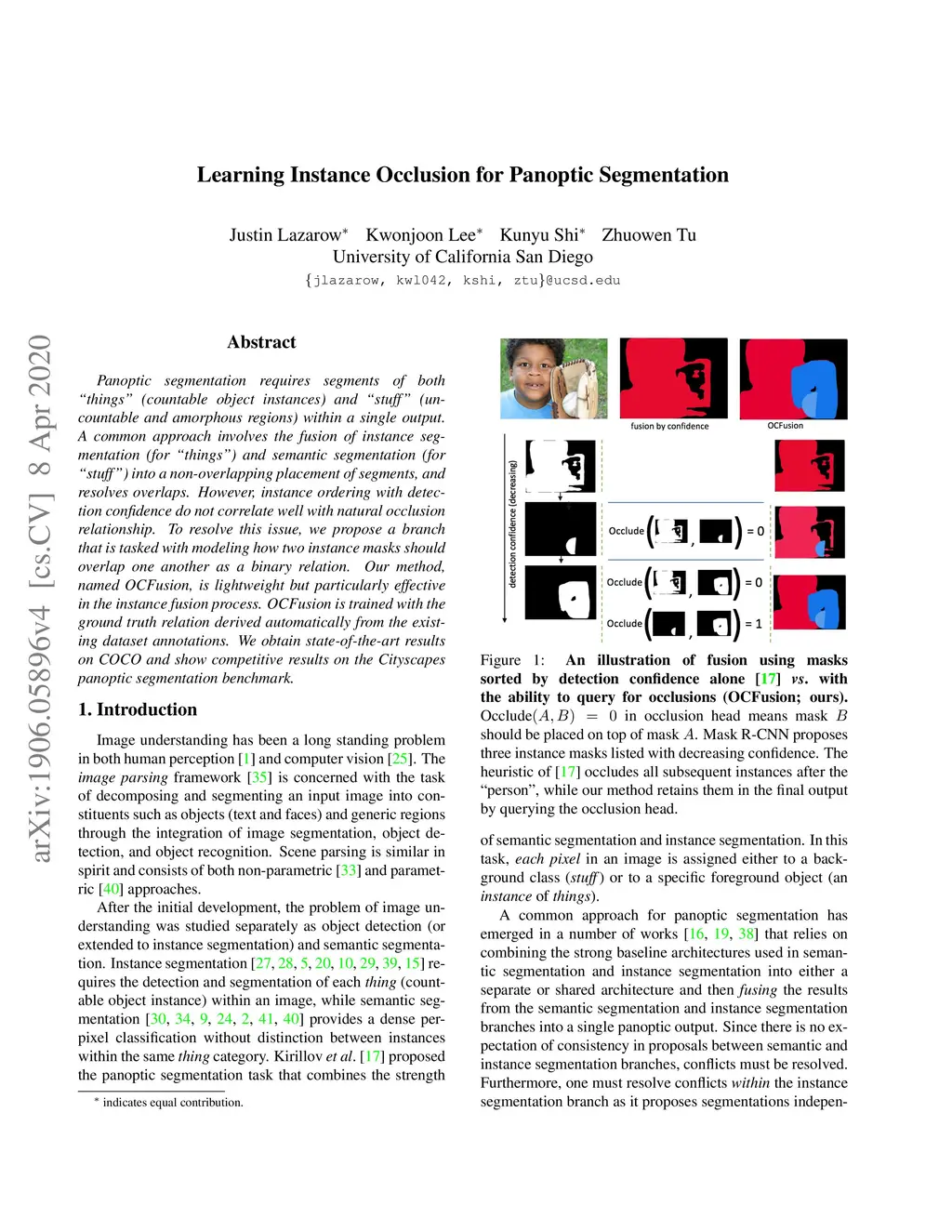
Panoptic segmentation requires segments of both "things" (countable object instances) and "stuff" (uncountable and amorphous regions) within a single output. A common approach involves the fusion of instance segmentation (for "things") and semantic segmentation (for "stuff") into a non-overlapping placement of segments, and resolves occlusions (or overlaps). However, instance ordering with detection confidence do not correlate well with natural occlusion relationship. To resolve this issue, we propose a branch that is tasked with modeling how two instance masks should overlap one another as a binary relation. Our method, named OCFusion, is lightweight but particularly effective on the "things" portion of the standard panoptic segmentation benchmarks, bringing significant gains (up to +3.2 PQ^Th and +2.0 overall PQ) on the COCO dataset --- only requiring a short amount of fine-tuning. OCFusion is trained with the ground truth relation derived automatically from the existing dataset annotations. We obtain state-of-the-art results on COCO and show competitive results on the Cityscapes panoptic segmentation benchmark.
View on arXiv