
Towards More Accurate Automatic Sleep Staging via Deep Transfer Learning
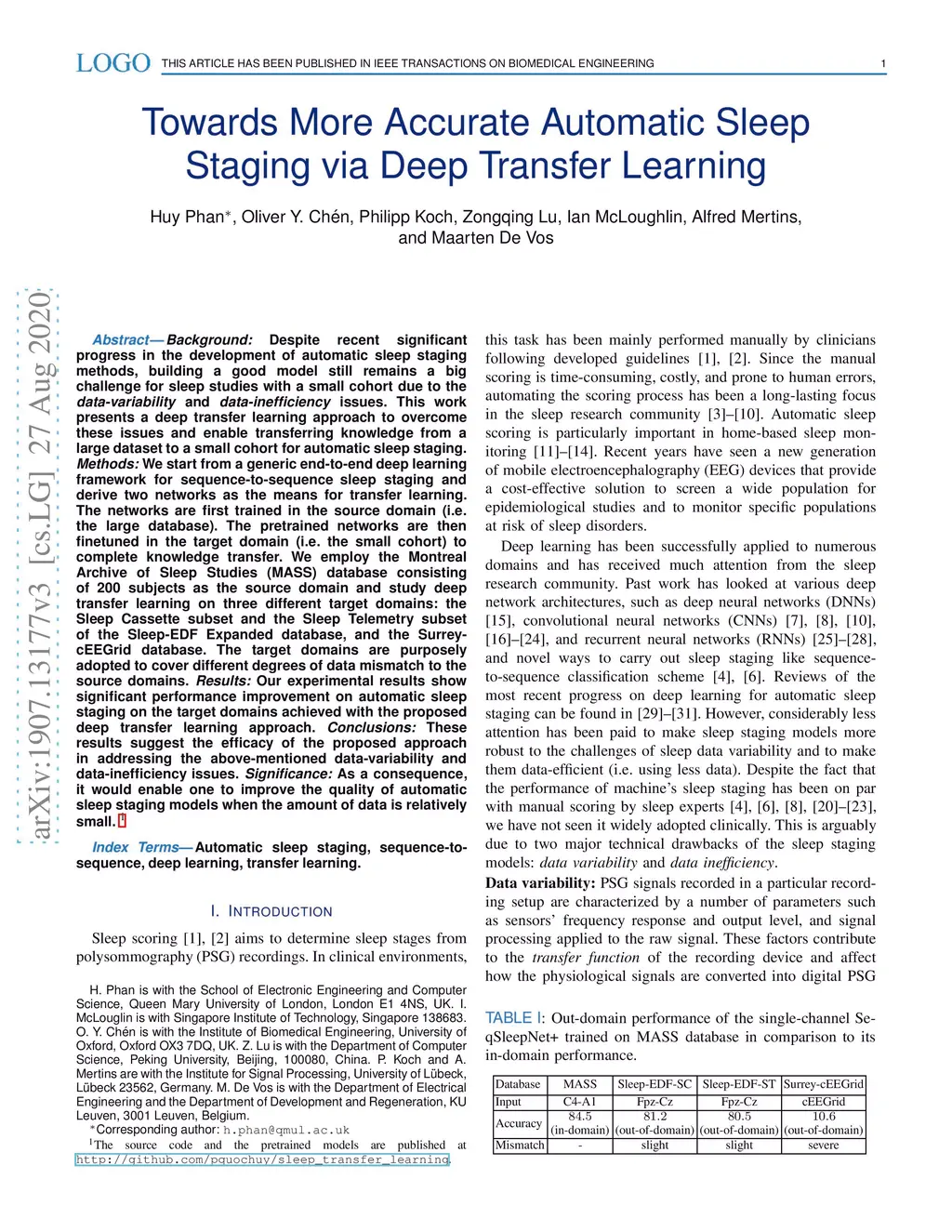
Despite recent significant progress in the development of automatic sleep staging methods, building a good model still remains a big challenge for sleep studies with a small cohort. First, directly employing sleep staging models trained with large public sleep databases in these studies results in degrading performance due to data mismatch. Second, state-of-the-art sleep staging algorithms based on deep neural networks require a large amount of training data. This work presents a deep transfer learning approach to overcome the data mismatch problem and enable transferring knowledge from a large dataset to a small cohort for automatic sleep staging. We start from a generic end-to-end deep learning framework for sequence-to-sequence sleep staging and derive two networks as the means for transfer learning. The networks are first trained in the source domain (i.e. the large database). The pretrained networks are then finetuned in the target domain (i.e. the small cohort) to complete knowledge transfer. We employ the Montreal Archive of Sleep Studies (MASS) database consisting of 200 subjects as the source domain and study deep transfer learning on three different target domains: the Sleep Cassette subset and the Sleep Telemetry subset of the Sleep-EDF Expanded database, and the Surrey-cEEGrid database. The target domains are purposely adopted to cover different degrees of data mismatch to the source domain. Our results show significant performance improvement on automatic sleep staging on the target domains achieved with the proposed deep transfer learning approach.
View on arXiv