
Coordinate-wise Armijo's condition
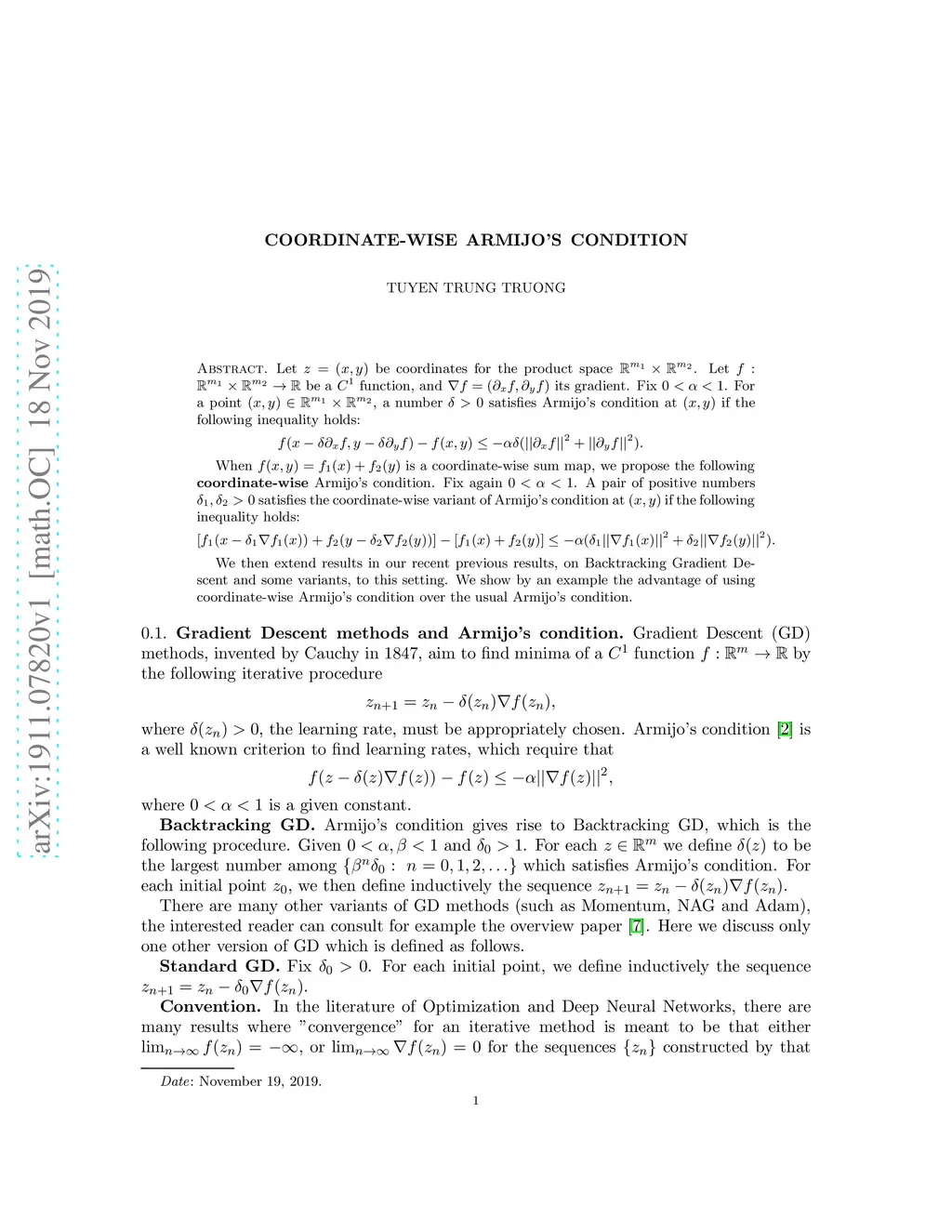
Let be coordinates for the product space . Let be a function, and its gradient. Fix . For a point , a number satisfies Armijo's condition at if the following inequality holds: \begin{eqnarray*} f(x-\delta \partial _xf,y-\delta \partial _yf)-f(x,y)\leq -\alpha \delta (||\partial _xf||^2+||\partial _yf||^2). \end{eqnarray*} When is a coordinate-wise sum map, we propose the following {\bf coordinate-wise} Armijo's condition. Fix again . A pair of positive numbers satisfies the coordinate-wise variant of Armijo's condition at if the following inequality holds: \begin{eqnarray*} [f_1(x-\delta _1\nabla f_1(x))+f_2(y-\delta _2\nabla f_2(y))]-[f_1(x)+f_2(y)]\leq -\alpha (\delta _1||\nabla f_1(x)||^2+\delta _2||\nabla f_2(y)||^2). \end{eqnarray*} We then extend results in our recent previous results, on Backtracking Gradient Descent and some variants, to this setting. We show by an example the advantage of using coordinate-wise Armijo's condition over the usual Armijo's condition.
View on arXiv