
Forecasting future action sequences with attention: a new approach to
weakly supervised action forecasting
- AI4TS
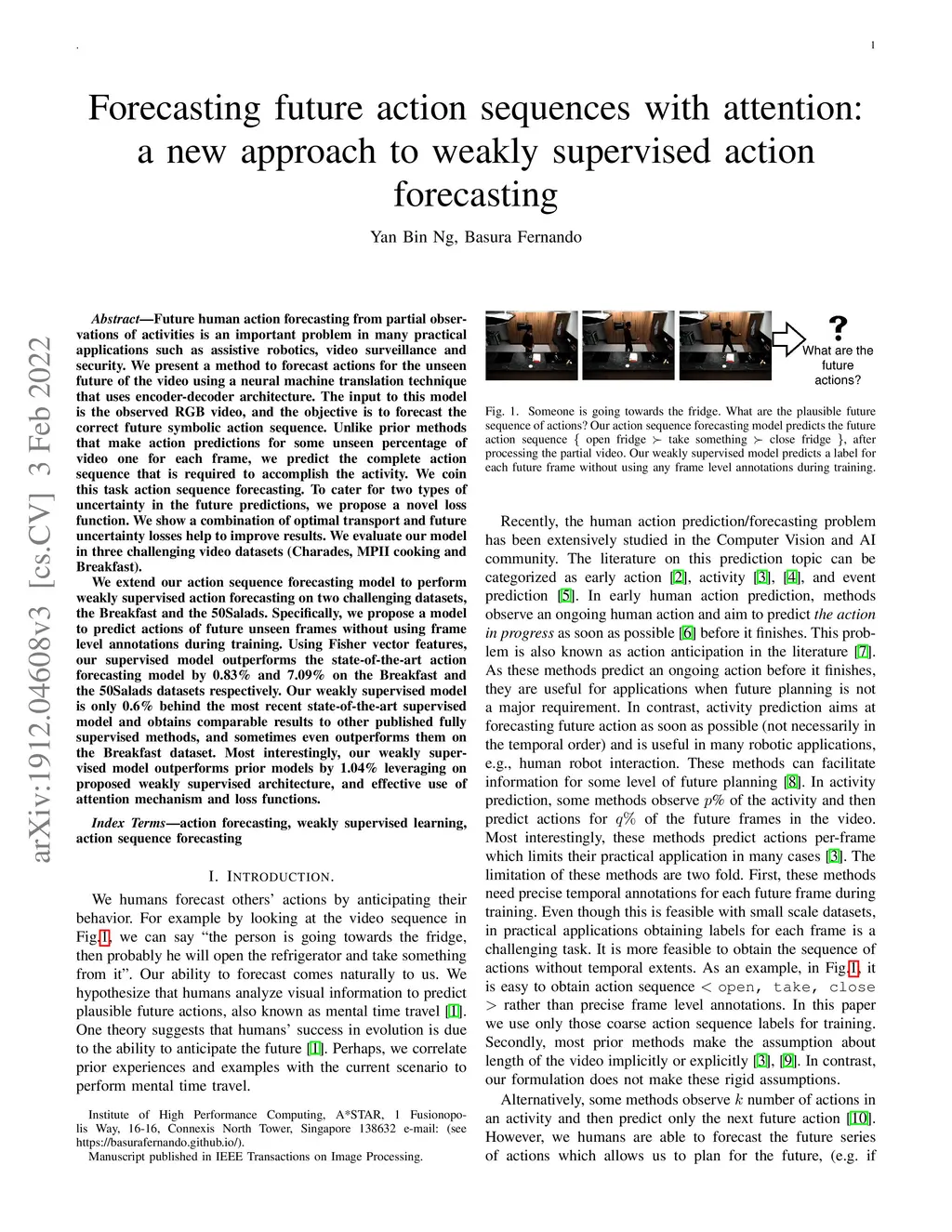
Future human action forecasting from partial observations of activities is an important problem in many practical applications such as assistive robotics, video surveillance and security. We present a method to forecast actions for the unseen future of the video using a neural machine translation technique that uses encoder-decoder architecture. The input to this model is the observed RGB video, and the objective is to forecast the correct future symbolic action sequence. Unlike prior methods that make action predictions for some unseen percentage of video one for each frame, we predict the complete action sequence that is required to accomplish the activity. We coin this task action sequence forecasting. To cater for two types of uncertainty in the future predictions, we propose a novel loss function. We show a combination of optimal transport and future uncertainty losses help to boost results. We evaluate our model in three challenging video datasets (Charades, MPII cooking and Breakfast). We extend our action sequence forecasting model to perform weakly supervised action forecasting. Specifically, we propose a model to predict actions of future unseen frames without using frame level annotations during training. Our fully supervised model outperforms the state-of-the-art action forecasting model by 4.6%. Our weakly supervised model is only 0.6% behind the most recent state-of-the-art supervised model and obtains comparable results to other published fully supervised methods, and sometimes even outperforms them.
View on arXiv