
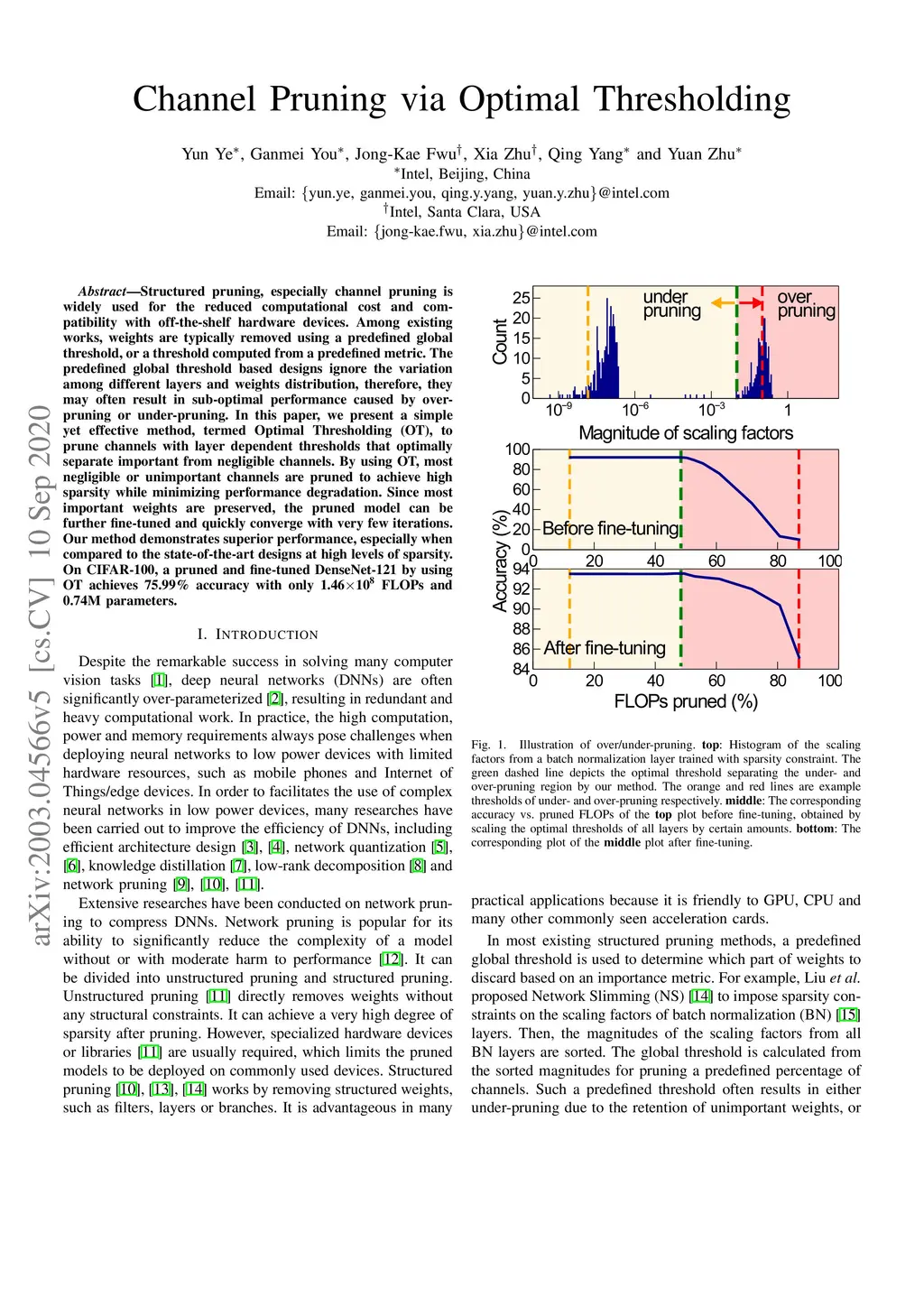
Structured pruning, especially channel pruning is widely used for the reduced computational cost and the compatibility with off-the-shelf hardware devices. Among existing works, weights are typically removed using a predefined global threshold, or a threshold computed from a predefined metric. The predefined global threshold based designs ignore the variation among different layers and weights distribution, therefore, they may often result in sub-optimal performance caused by over-pruning or under-pruning. In this paper, we present a simple yet effective method, termed Optimal Thresholding (OT), to prune channels with layer dependent thresholds that optimally separate important from negligible channels. By using OT, most negligible or unimportant channels are pruned to achieve high sparsity while minimizing performance degradation. Since most important weights are preserved, the pruned model can be further fine-tuned and quickly converge with very few iterations. Our method demonstrates superior performance, especially when compared to the state-of-the-art designs at high levels of sparsity. On CIFAR-100, a pruned and fine-tuned DenseNet-121 by using OT achieves 75.99% accuracy with only 1.46e8 FLOPs and 0.71M parameters.
View on arXiv