
Understanding the Effects of Data Parallelism and Sparsity on Neural
Network Training
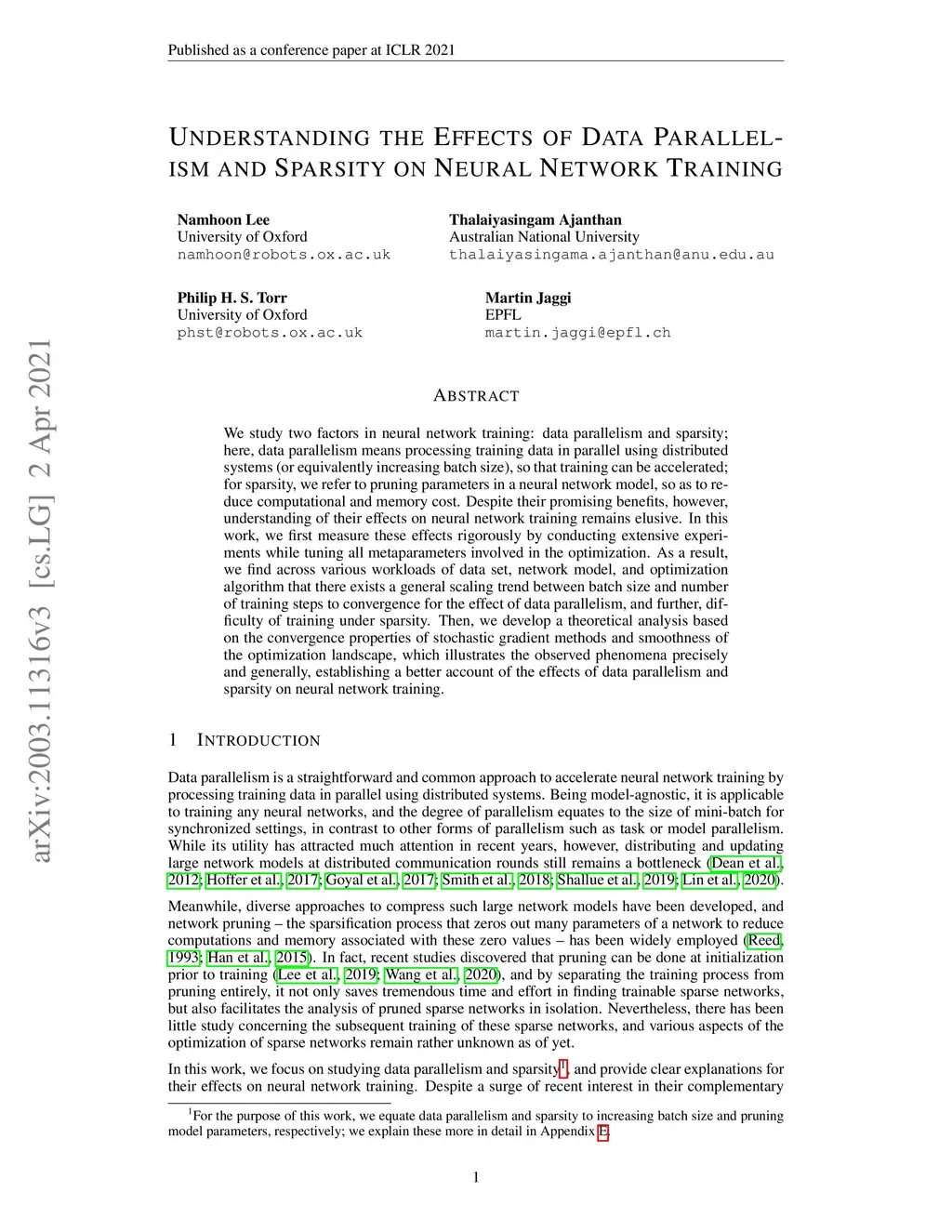
Network pruning is an effective methodology to compress large neural networks, and sparse neural networks obtained by pruning can benefit from their reduced memory and computational costs at use. Notably, recent studies have found that it is possible to find a trainable sparse neural network even at random initialization prior to training. While this approach of pruning at initialization turned out to be highly effective, there has been little study concerning the subsequent training of these sparse neural networks. In this work, we focus on studying the effects of data parallelism and sparsity on neural network training. For data parallelism, this usually means processing training data in parallel using distributed systems, or equivalently increasing batch size, so that the training process can be accelerated. To this end, we first measure the effects for different study cases of batch size and sparsity level while tuning all metaparameters involved in the optimization. As a result, we find across various workloads of data set, network model, and optimization algorithms that there exists a general scaling trend in the relationship between batch size and number of training steps to convergence for the effect of data parallelism, irrespective of sparsity levels. Also, the effect of data parallelism in training sparse networks turns out to be no worse, or can be even better when the training is done by a momentum based optimizer, than that in training densely parameterized networks, despite the general difficulty of training sparse networks. We further provide theoretical insights based on the convergence properties of stochastic gradient methods and a smoothness analysis, so as to precisely illustrate our empirical findings and hence to develop a better account of the effects of data parallelism and sparsity on neural network training.
View on arXiv