
Decoding EEG Rhythms During Action Observation, Motor Imagery, and
Execution for Standing and Sitting
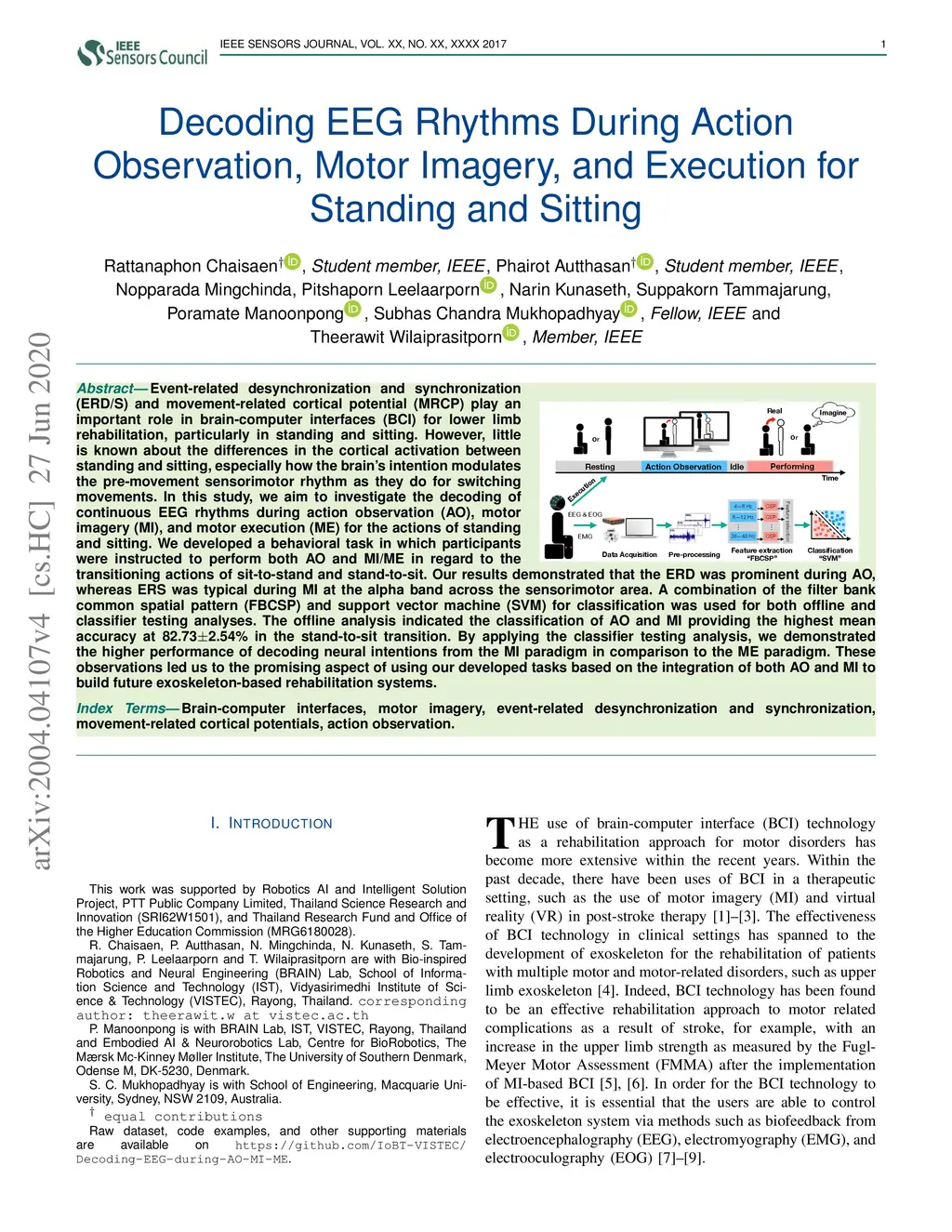
Event-related desynchronization and synchronization (ERD/S) and movement-related cortical potential (MRCP) play an important role in brain-computer interfaces (BCI) for lower limb rehabilitation, particularly in standing and sitting. However, little is known about the differences in the cortical activation between standing and sitting, especially how the brain's intention modulates the pre-movement sensorimotor rhythm as they do for switching movements. In this study, we aim to investigate the decoding of continuous EEG rhythms during action observation (AO), motor imagery (MI), and motor execution (ME) for standing and sitting. We developed a behavioral task in which participants were instructed to perform both AO and MI/ME in regard to the actions of sit-to-stand and stand-to-sit. Our results demonstrated that the ERD was prominent during AO, whereas ERS was typical during MI at the alpha band across the sensorimotor area. A combination of the filter bank common spatial pattern (FBCSP) and support vector machine (SVM) for classification was used for both offline and pseudo-online analyses. The offline analysis indicated the classification of AO and MI providing the highest mean accuracy at 82.732.38\% in stand-to-sit transition. By applying the pseudo-online analysis, we demonstrated the higher performance of decoding neural intentions from the MI paradigm in comparison to the ME paradigm. These observations led us to the promising aspect of using our developed tasks based on the integration of both AO and MI to build future exoskeleton-based rehabilitation systems.
View on arXiv