
Recurrent Convolutional Neural Networks help to predict location of
Earthquakes
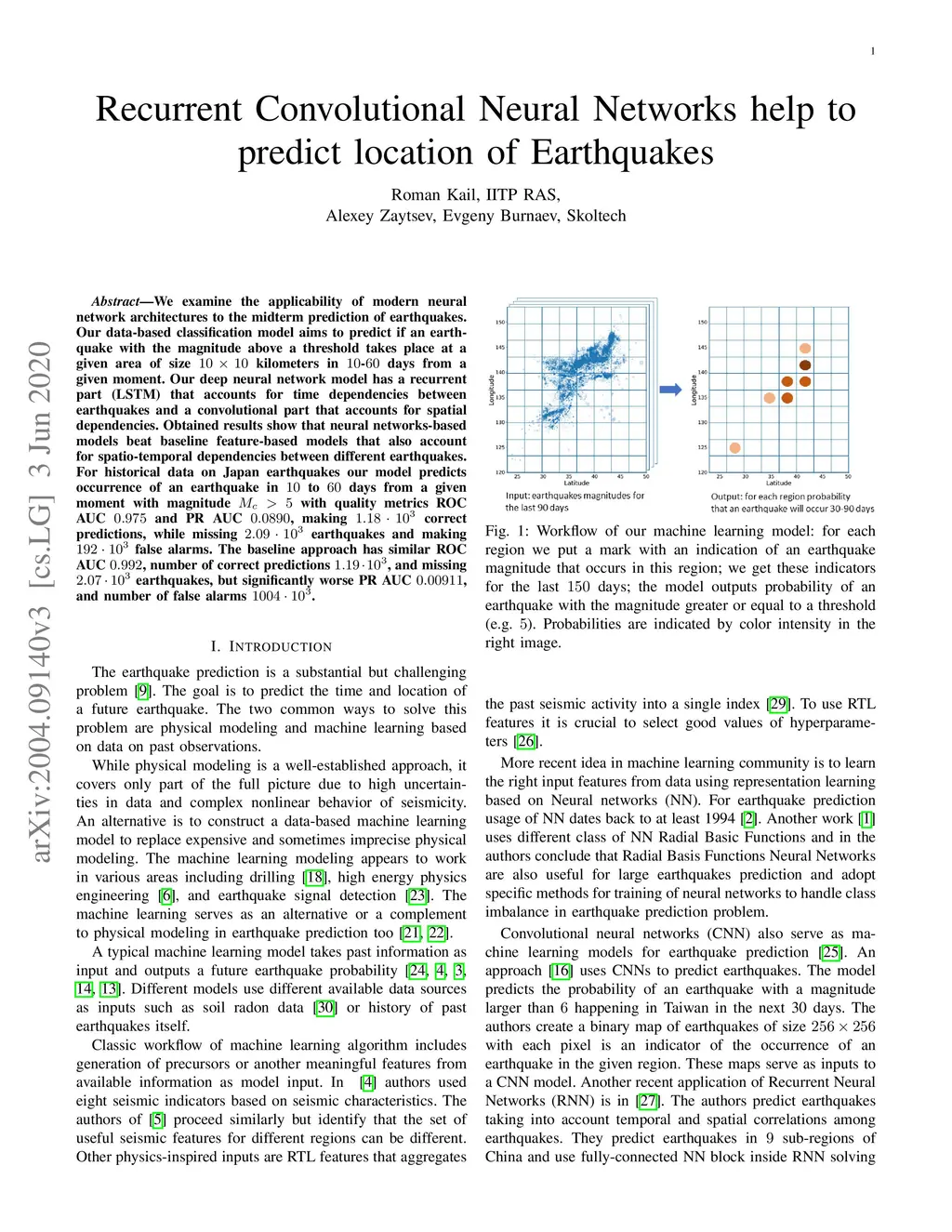
We examine the applicability of modern neural network architectures to the midterm prediction of earthquakes. Our data-based classification model aims to predict if an earthquake with the magnitude above a threshold takes place at a given area of size kilometers in - days from a given moment. Our deep neural network model has a recurrent part (LSTM) that accounts for time dependencies between earthquakes and a convolutional part that accounts for spatial dependencies. Obtained results show that neural networks-based models beat baseline feature-based models that also account for spatio-temporal dependencies between different earthquakes. For historical data on Japan earthquakes - our best model predicts earthquakes with magnitude with quality metrics ROC AUC and PR AUC , making correct predictions, while missing earthquakes and making false alarms. The baseline approach has similar ROC AUC , the number of correct predictions , and missing earthquakes, but significantly worse PR AUC , and the number of false alarms .
View on arXiv