
Incorporating Learnable Membrane Time Constant to Enhance Learning of
Spiking Neural Networks
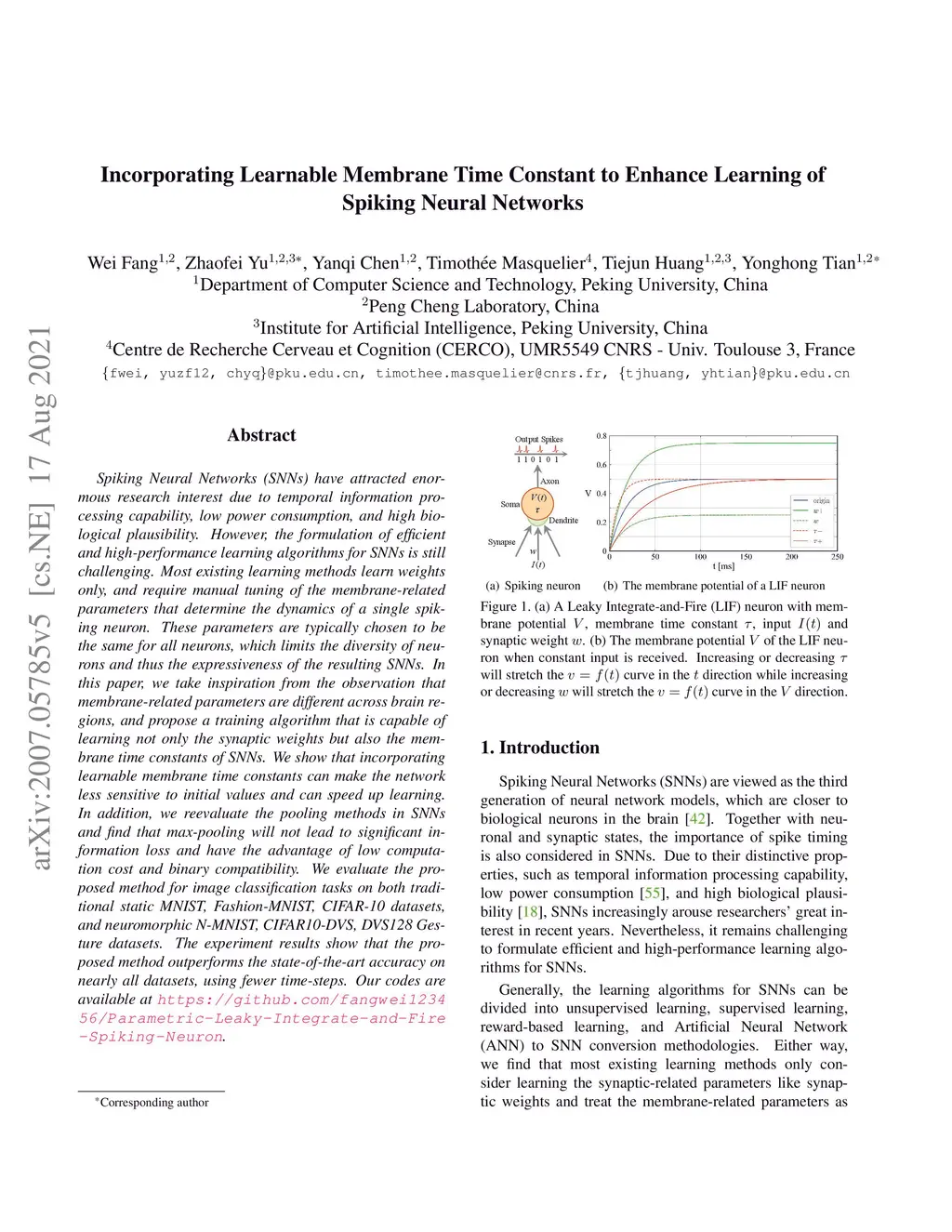
Spiking Neural Networks (SNNs) have attracted enormous research interest due to temporal information processing capability, low power consumption, and high biological plausibility. However, the formulation of efficient and high-performance learning algorithms for SNNs is still challenging. Most existing learning methods learn the synaptic-related parameters only, and require manual tuning of the membrane-related parameters that determine the dynamics of single spiking neurons. These parameters are typically chosen to be the same for all neurons, which limits the diversity of neurons and thus the expressiveness of the resulting SNNs. In this paper, we take inspiration from the observation that membrane-related parameters are different across brain regions, and propose a training algorithm that is capable to learn not only the synaptic weights but also the membrane time constants of SNN. We show that incorporating learnable membrane time constants can make the network less sensitive to initial values and can speed up learning. In addition, we reevaluate the pooling methods in SNNs and find that max-pooling is able to increase the fitting capacity of SNNs in temporal tasks, as well as reduce the computation cost. We evaluate the proposed method for image classification tasks on both traditional static MNIST, Fashion-MNIST, CIFAR-10 datasets, and neuromorphic N-MNIST, CIFAR10-DVS, DVS128 Gesture datasets. The experiment results show that the proposed method outperforms the state-of-the-art accuracy on nearly all datasets, using fewer time-steps.
View on arXiv