
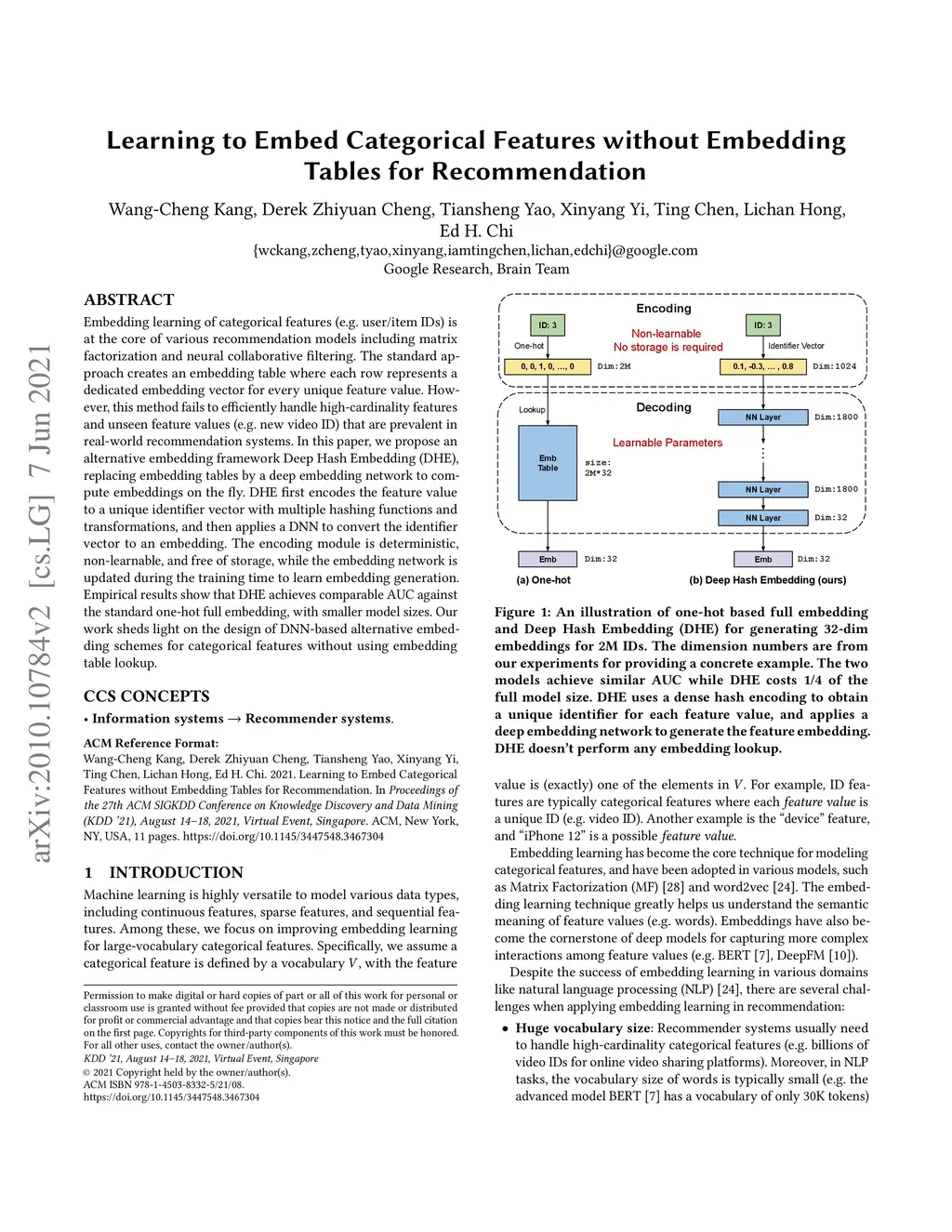
Embedding learning for large-vocabulary categorical features (e.g. user/item IDs, and words) is crucial for deep learning, and especially neural models for recommendation systems and natural language understanding tasks. Typically, the model creates a huge embedding table that each row represents a dedicated embedding vector for every feature value. In practice, to handle new (i.e., out-of-vocab) feature values and reduce the storage cost, the hashing trick is often adopted, that randomly maps feature values to a smaller number of hashing buckets. Essentially, thess embedding methods can be viewed as 1-layer wide neural networks with one-hot encodings. In this paper, we propose an alternative embedding framework Deep Hash Embedding (DHE), with non-one-hot encodings and a deep neural network (embedding network) to compute embeddings on the fly without having to store them. DHE first encodes the feature value to a dense vector with multiple hashing functions and then applies a DNN to generate the embedding. DHE is collision-free as the dense hashing encodings are unique identifiers for both in-vocab and out-of-vocab feature values. The encoding module is deterministic, non-learnable, and free of storage, while the embedding network is updated during the training time to memorize embedding information. Empirical results show that DHE outperforms state-of-the-art hashing-based embedding learning algorithms, and achieves comparable AUC against the standard one-hot encoding, with significantly smaller model sizes. Our work sheds light on design of DNN-based alternative embedding schemes for categorical features without using embedding table lookup.
View on arXiv