
An Empirical Study of Assumptions in Bayesian Optimisation
Haitham Bou Ammar
Abstract
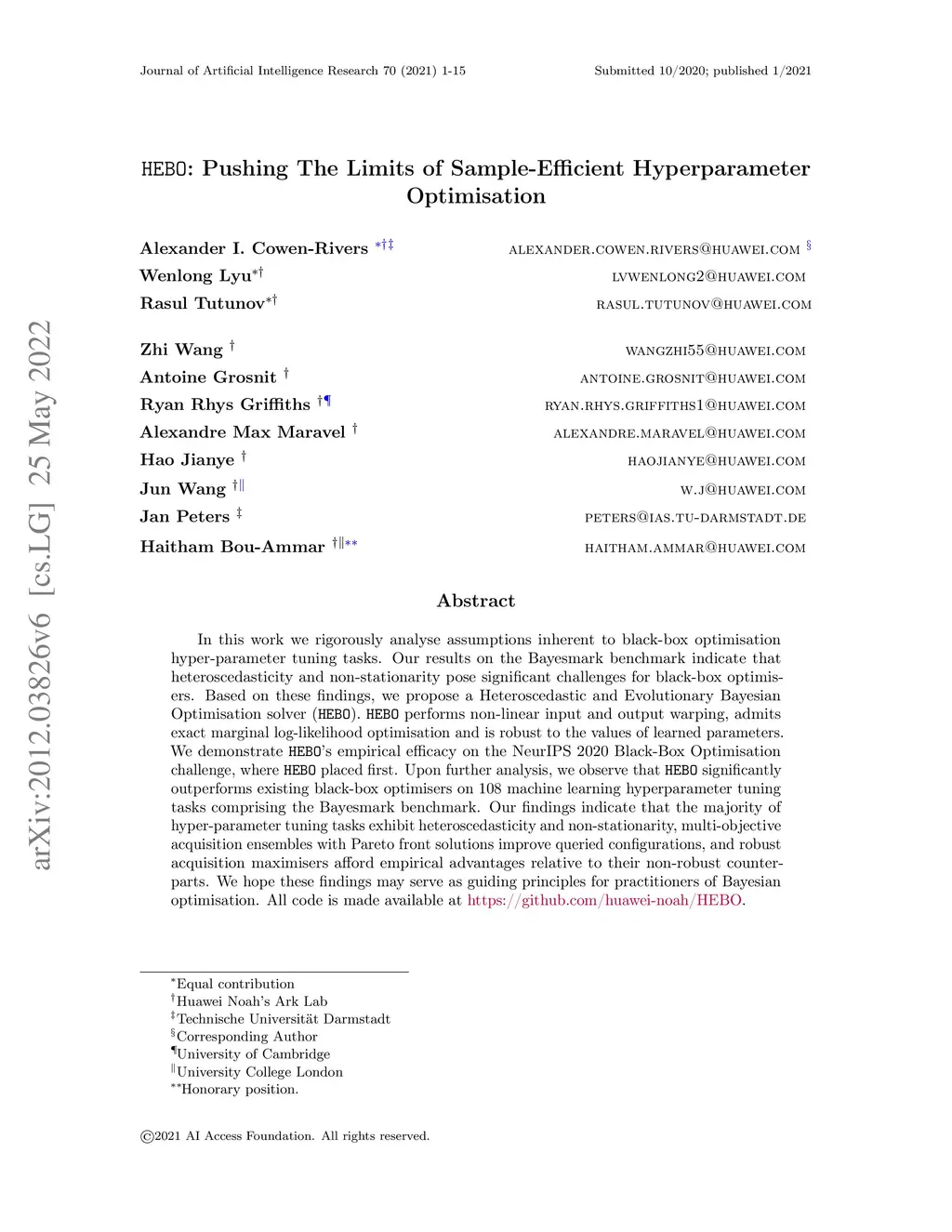
Inspired by the increasing desire to efficiently tune machine learning hyper-parameters, in this work we rigorously analyse conventional and non-conventional assumptions inherent to Bayesian optimisation. Across an extensive set of experiments we conclude that: 1) the majority of hyper-parameter tuning tasks exhibit heteroscedasticity and non-stationarity, 2) multi-objective acquisition ensembles with Pareto-front solutions significantly improve queried configurations, and 3) robust acquisition maximisation affords empirical advantages relative to its non-robust counterparts. We hope these findings may serve as guiding principles, both for practitioners and for further research in the field.
View on arXivComments on this paper