
Disentangled Sequence Clustering for Human Intention Inference
- DRL
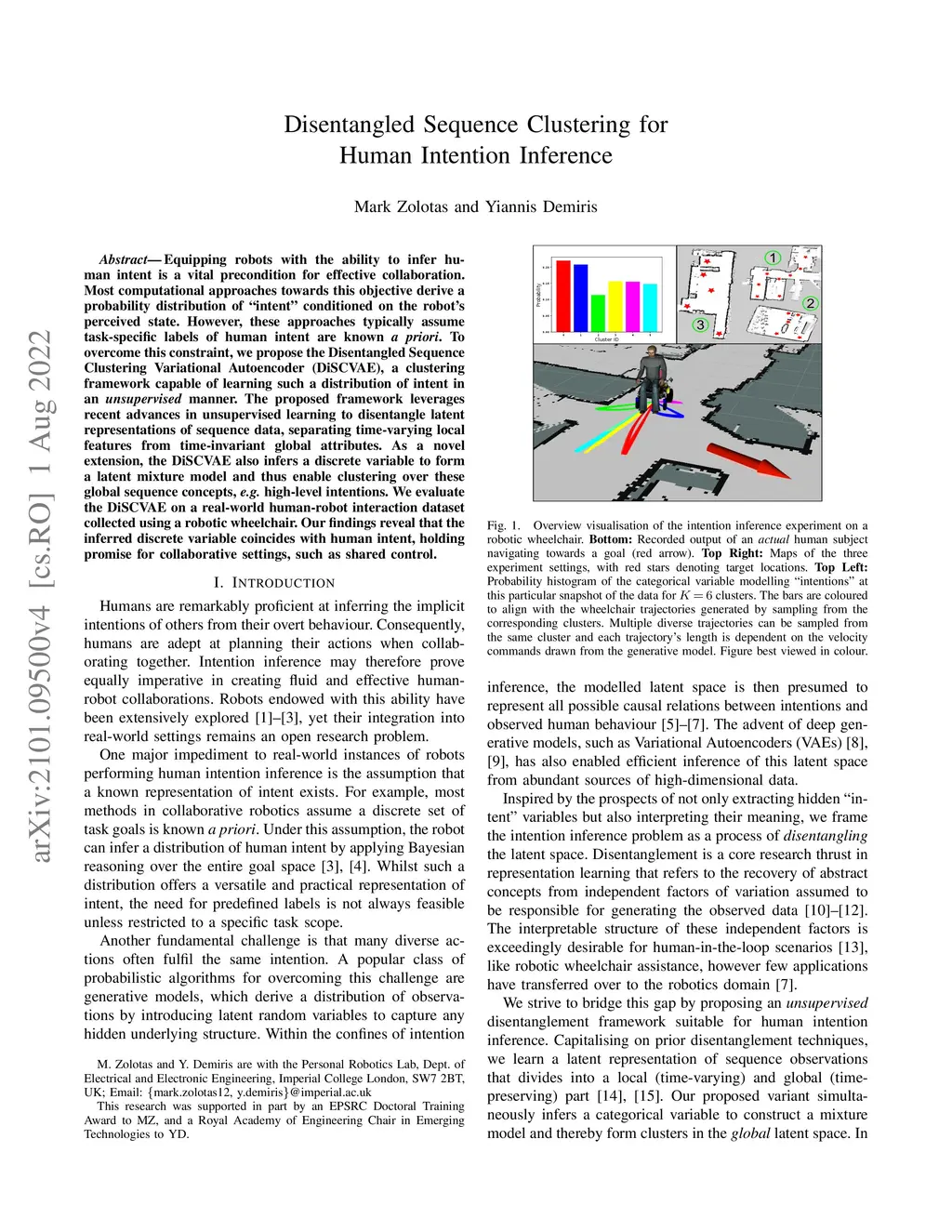
Equipping robots with the ability to infer human intent is a vital precondition for effective collaboration. Most computational approaches towards this objective derive a probabilistic distribution of "intent" conditioned on the robot's perceived sensory state. However, these approaches typically assume task-specific labels of human intent are known a priori. To overcome this constraint, we propose the Disentangled Sequence Clustering Variational Autoencoder (DiSCVAE), a clustering framework capable of learning such a distribution of intent in an unsupervised manner. The DiSCVAE leverages recent advances in unsupervised learning to recover a disentangled latent representation of sequential data, separating time-varying local features from time-invariant global aspects. Though unlike previous frameworks for disentanglement, the proposed variant also infers a discrete variable to form a latent mixture model and enable clustering of global sequence concepts, e.g. intentions from observed human behaviour. To evaluate the DiSCVAE, we first validate its capacity to discover classes from unlabelled sequences using video datasets of bouncing digits and 2D animations. We then report results from a real-world human-robot interaction experiment conducted on a robotic wheelchair. Our findings reveal that the inferred discrete variable coincides with human intent and can thus improve assistance in collaborative settings, such as shared control.
View on arXiv