
Inapproximability of Minimizing a Pair of DNFs or Binary Decision Trees
Defining a Partial Boolean Function
- TPM
Abstract
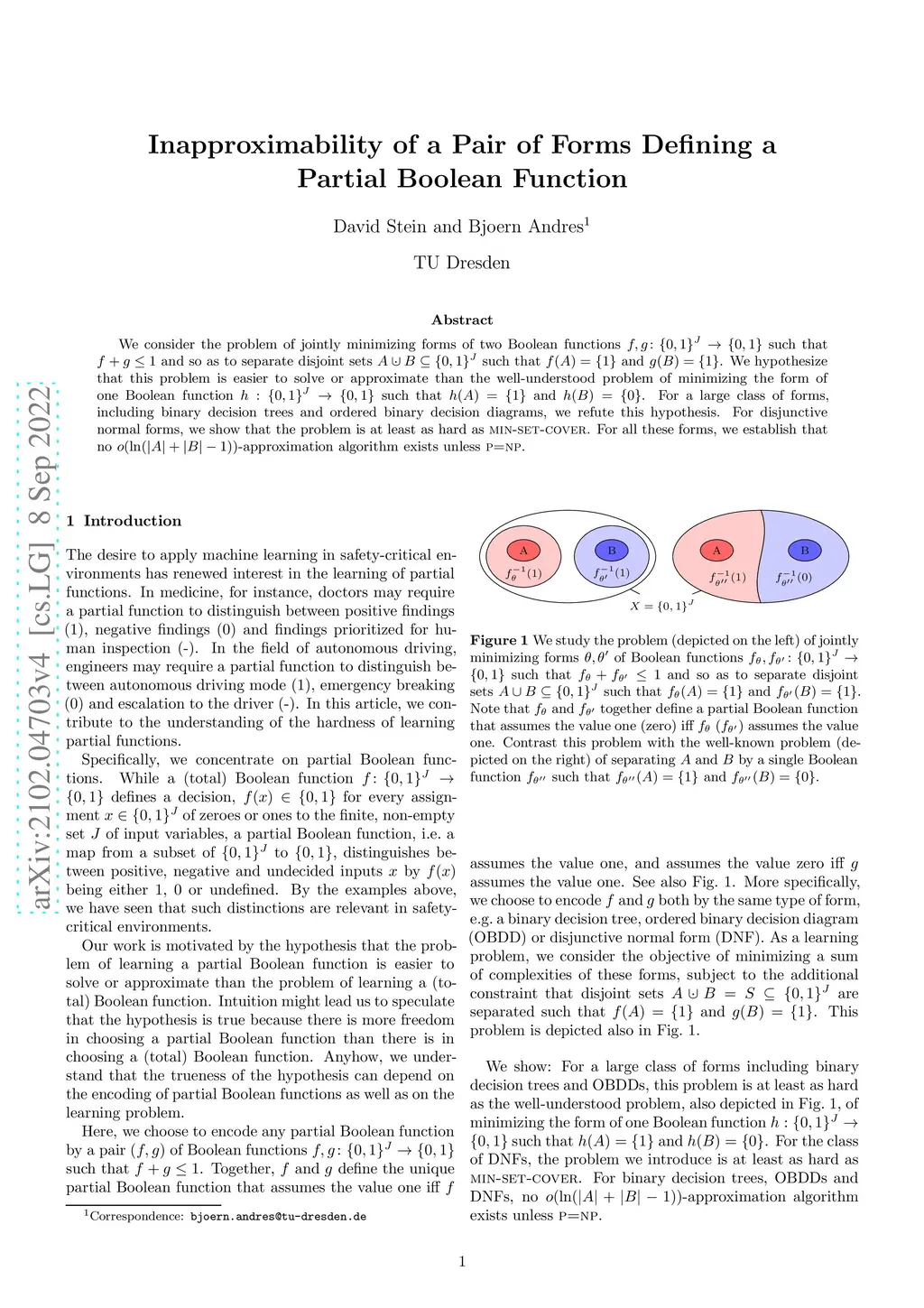
The desire to apply machine learning techniques in safety-critical environments has renewed interest in the learning of partial functions for distinguishing between positive, negative and unclear observations. We contribute to the understanding of the hardness of this problem. Specifically, we consider partial Boolean functions defined by a pair of Boolean functions such that and such that and are defined by disjunctive normal forms or binary decision trees. We show: Minimizing the sum of the lengths or depths of these forms while separating disjoint sets such that and is inapproximable to within for any , unless P=NP.
View on arXivComments on this paper