
Escaping the Big Data Paradigm with Compact Transformers
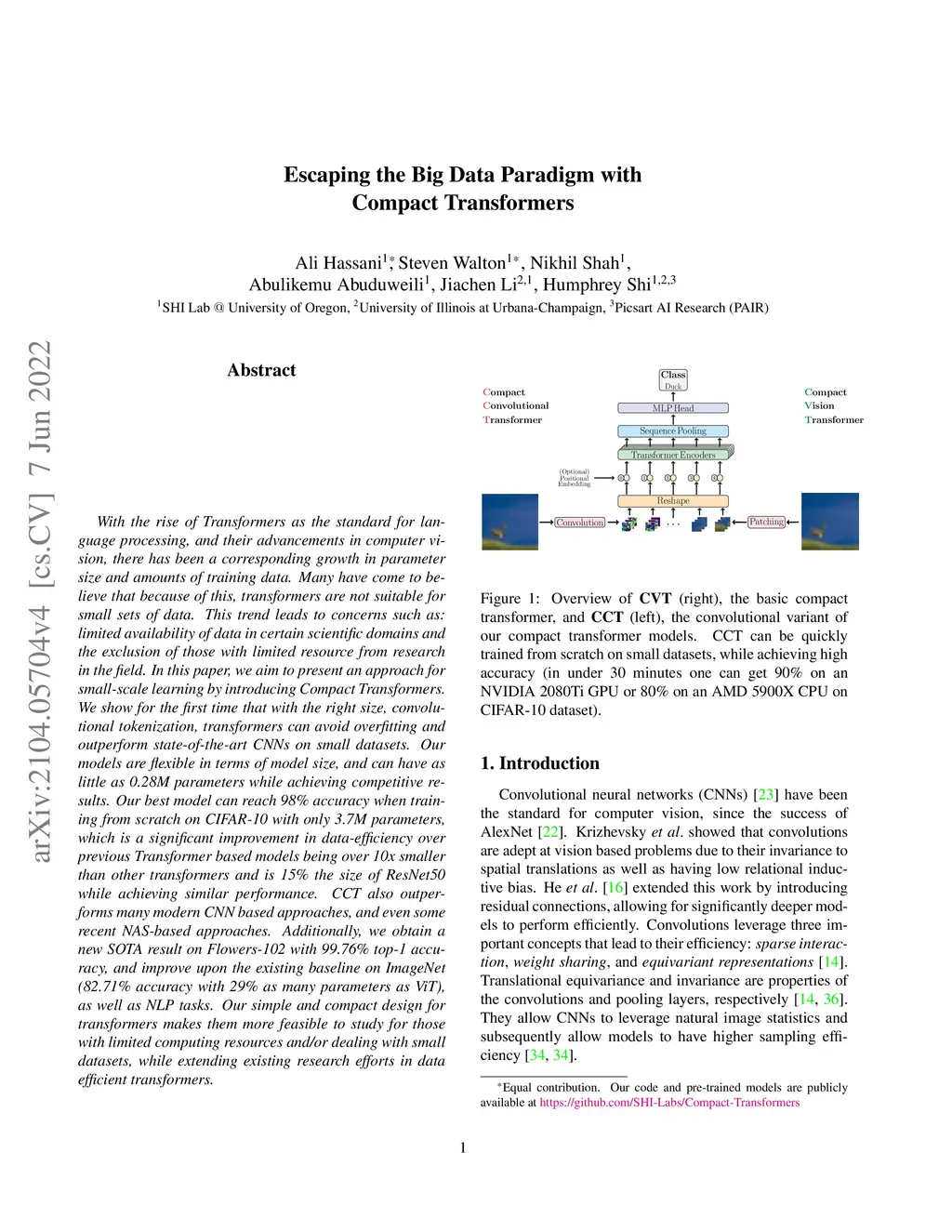
With the rise of Transformers as the standard for language processing, and their advancements in computer vision, along with their unprecedented size and amounts of training data, many have come to believe that they are not suitable for small sets of data. This trend leads to great concerns, including but not limited to: limited availability of data in certain scientific domains and the exclusion of those with limited resource from research in the field. In this paper, we dispel the myth that transformers are "data hungry" and therefore can only be applied to large sets of data. We show for the first time that with the right size and tokenization, transformers can perform head-to-head with state-of-the-art CNNs on small datasets, often with better accuracy and fewer parameters. Our model eliminates the requirement for class token and positional embeddings through a novel sequence pooling strategy and the use of convolution/s. It is flexible in terms of model size, and can have as little as 0.28M parameters while achieving good results. Our model can reach 98.00% accuracy when training from scratch on CIFAR-10, which is a significant improvement over previous Transformer based models. It also outperforms many modern CNN based approaches, such as ResNet, and even some recent NAS-based approaches, such as Proxyless-NAS. Our simple and compact design democratizes transformers by making them accessible to those with limited computing resources and/or dealing with small datasets. Our method also works on larger datasets, such as ImageNet (82.71% accuracy with 29% parameters of ViT), and NLP tasks as well. Our code and pre-trained models are publicly available at https://github.com/SHI-Labs/Compact-Transformers.
View on arXiv