All Papers
0 / 0 papers shown
Title |
|---|

Title |
|---|
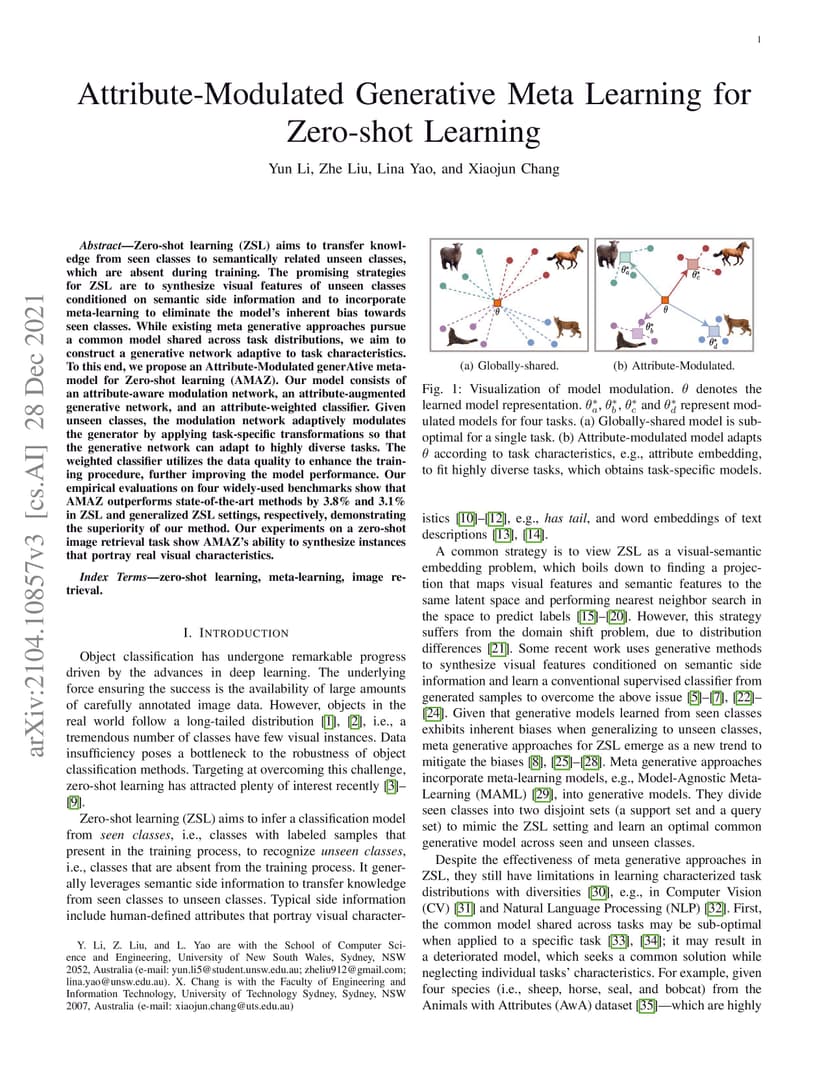
Zero-shot learning (ZSL) aims to transfer knowledge from seen classes to semantically related unseen classes, which are absent during training. The promising strategies for ZSL are to synthesize visual features of unseen classes conditioned on semantic side information and to incorporate meta-learning to eliminate the model's inherent bias towards seen classes. While existing meta generative approaches pursue a common model shared across task distributions, we aim to construct a generative network adaptive to task characteristics. To this end, we propose an Attribute-Modulated generAtive meta-model for Zero-shot learning (AMAZ). Our model consists of an attribute-aware modulation network, an attribute-augmented generative network, and an attribute-weighted classifier. Given unseen classes, the modulation network adaptively modulates the generator by applying task-specific transformations so that the generative network can adapt to highly diverse tasks. The weighted classifier utilizes the data quality to enhance the training procedure, further improving the model performance. Our empirical evaluations on four widely-used benchmarks show that AMAZ outperforms state-of-the-art methods by 3.8% and 3.1% in ZSL and generalized ZSL settings, respectively, demonstrating the superiority of our method. Our experiments on a zero-shot image retrieval task show AMAZ's ability to synthesize instances that portray real visual characteristics.
View on arXiv