
A Microarchitecture Implementation Framework for Online Learning with
Temporal Neural Networks
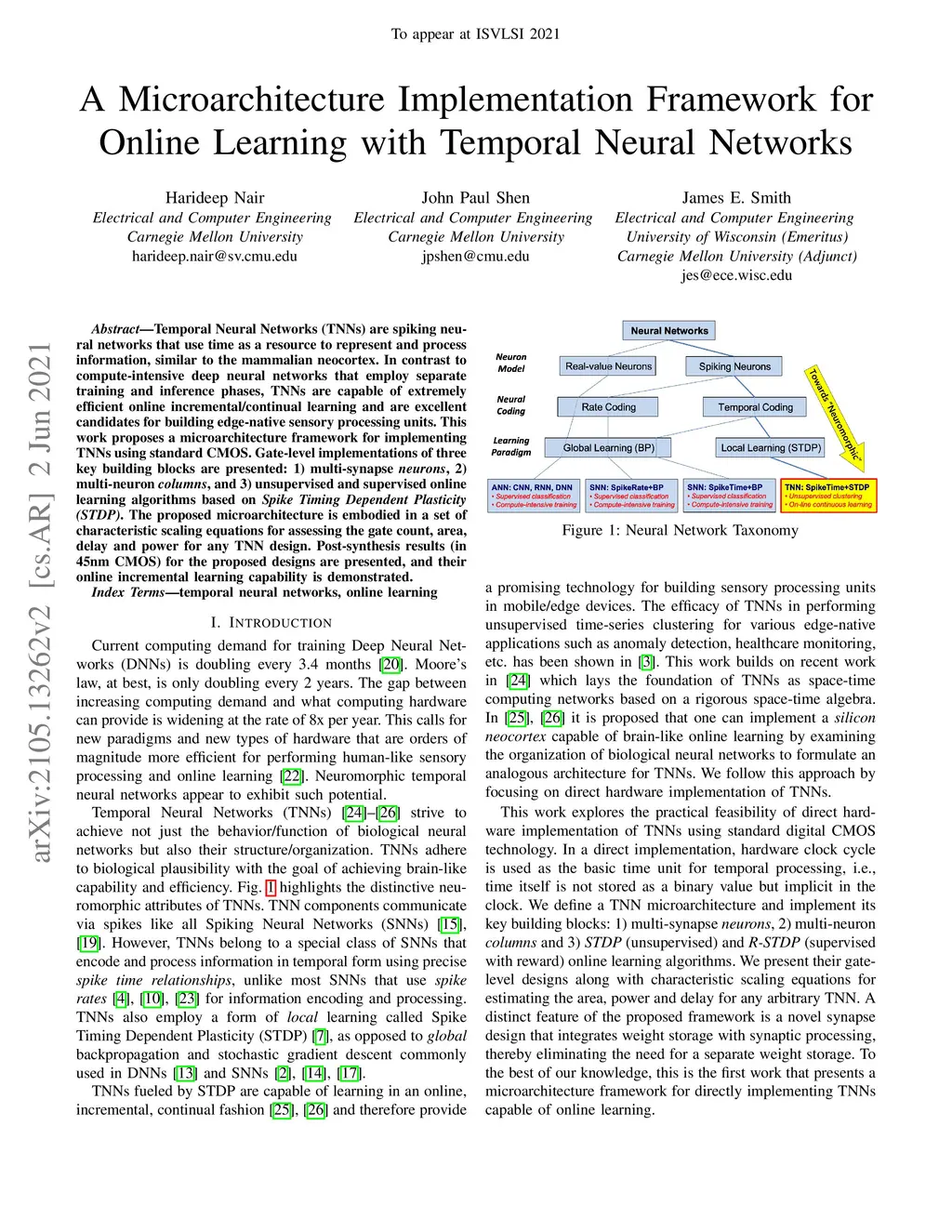
Temporal Neural Networks (TNNs) are spiking neural networks that use time as a resource to represent and process information, similar to the mammalian neocortex. In contrast to compute-intensive Deep Neural Networks that employ separate training and inference phases, TNNs are capable of extremely efficient online incremental/continuous learning and are excellent candidates for building edge-native sensory processing units. This work proposes a microarchitecture framework for implementing TNNs using standard CMOS. Gate-level implementations of three key building blocks are presented: 1) multi-synapse neurons, 2) multi-neuron columns, and 3) unsupervised and supervised online learning algorithms based on Spike Timing Dependent Plasticity (STDP). The TNN microarchitecture is embodied in a set of characteristic scaling equations for assessing the gate count, area, delay and power consumption for any TNN design. Post-synthesis results (in 45nm CMOS) for the proposed designs are presented, and their online incremental learning capability is demonstrated.
View on arXiv