
Throughput Maximization of UAV Networks
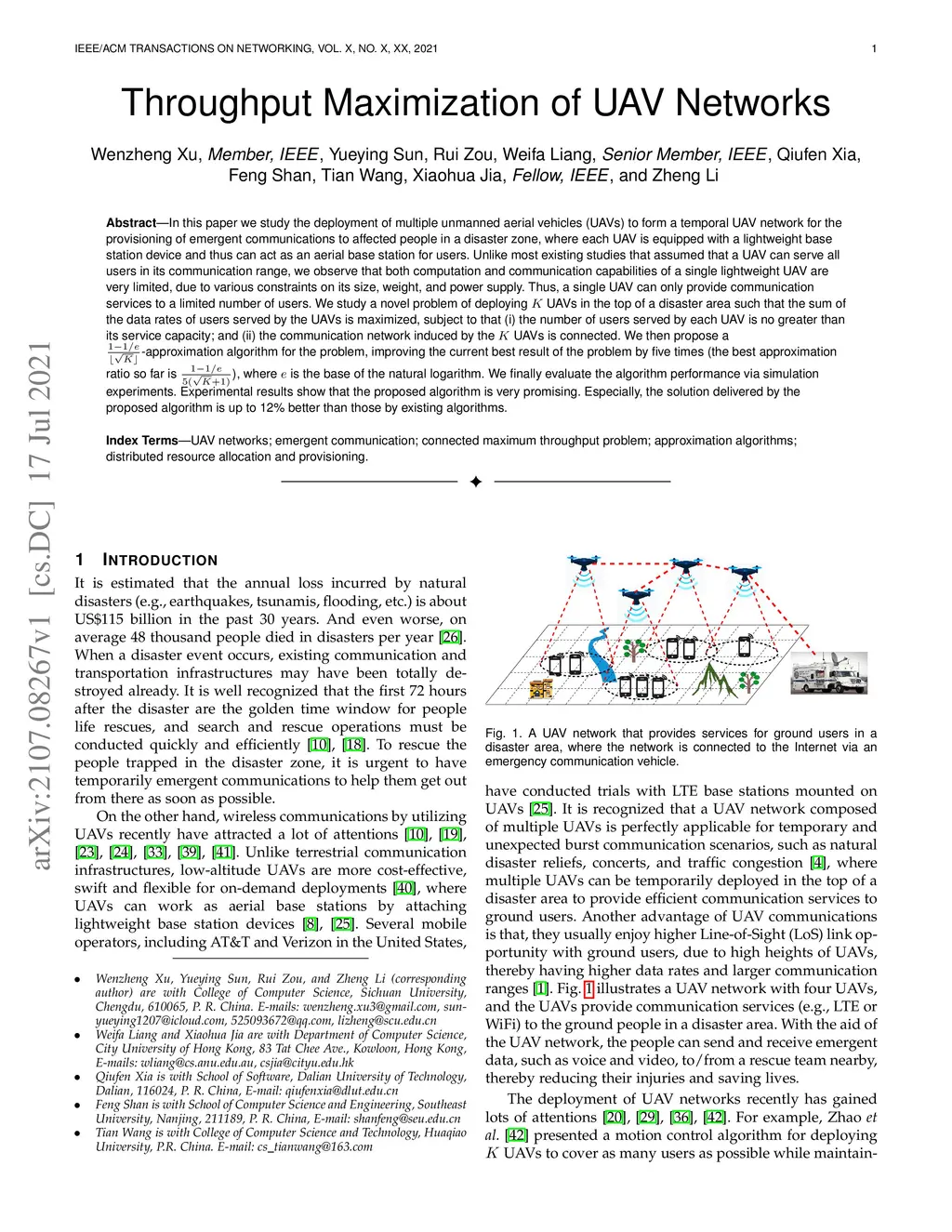
In this paper we study the deployment of multiple unmanned aerial vehicles (UAVs) to form a temporal UAV network for the provisioning of emergent communications to affected people in a disaster zone, where each UAV is equipped with a lightweight base station device and thus can act as an aerial base station for users. Unlike most existing studies that assumed that a UAV can serve all users in its communication range, we observe that both computation and communication capabilities of a single lightweight UAV are very limited, due to various constraints on its size, weight, and power supply. Thus, a single UAV can only provide communication services to a limited number of users. We study a novel problem of deploying UAVs in the top of a disaster area such that the sum of the data rates of users served by the UAVs is maximized, subject to that (i) the number of users served by each UAV is no greater than its service capacity; and (ii) the communication network induced by the UAVs is connected. We then propose a -approximation algorithm for the problem, improving the current best result of the problem by five times (the best approximation ratio so far is ), where is the base of the natural logarithm. We finally evaluate the algorithm performance via simulation experiments. Experimental results show that the proposed algorithm is very promising. Especially, the solution delivered by the proposed algorithm is up to 12% better than those by existing algorithms.
View on arXiv