
NPBDREG: A Non-parametric Bayesian Deep-Learning Based Approach for
Diffeomorphic Brain MRI Registration
- UQCV
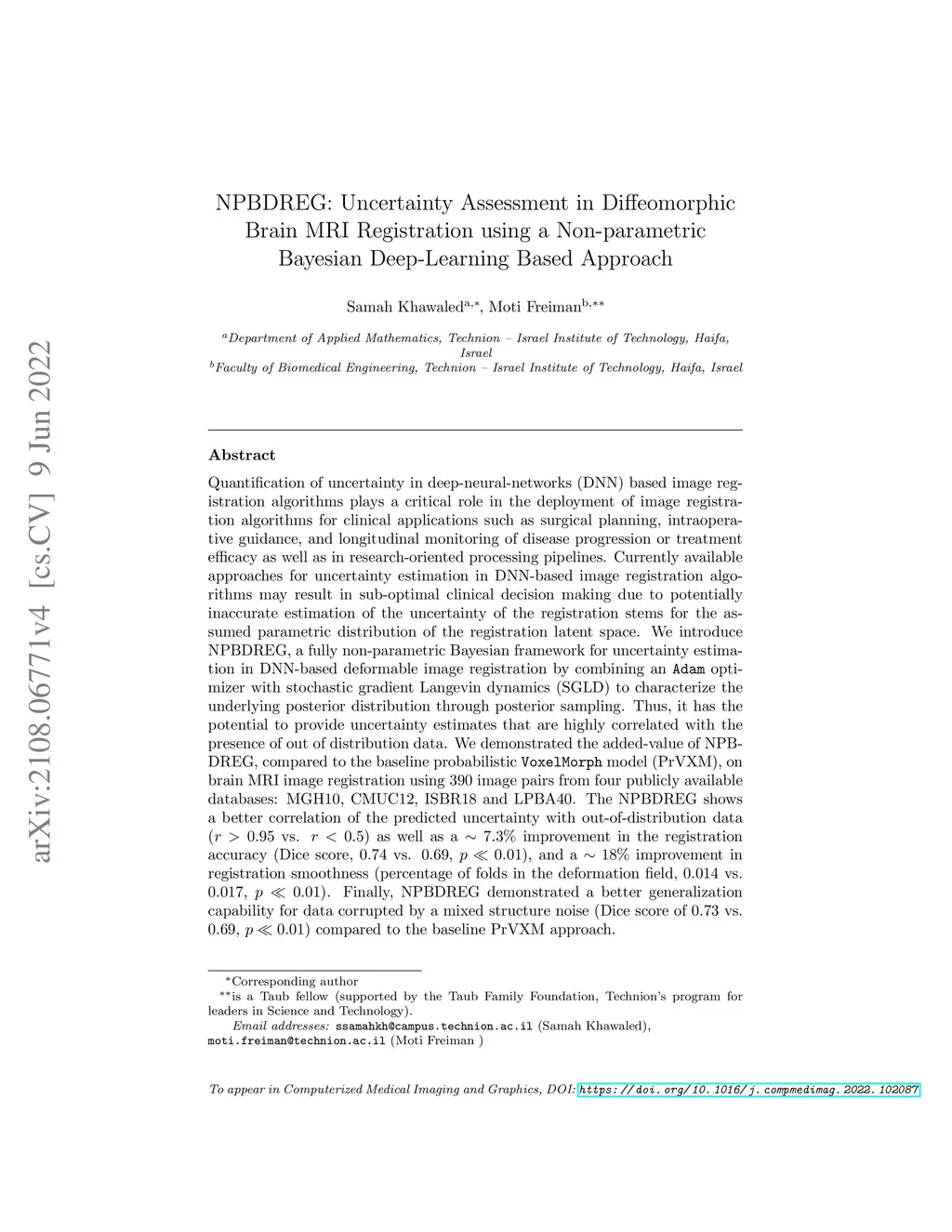
Quantification of uncertainty in deep-neural-networks (DNN) based image registration algorithms plays an important role in the safe deployment of real-world medical applications and research-oriented processing pipelines, and in improving generalization capabilities. Currently available approaches for uncertainty estimation, including the variational encoder-decoder architecture and the inference-time dropout approach, require specific network architectures and assume parametric distribution of the latent space which may result in sub-optimal characterization of the posterior distribution for the predicted deformation-fields. We introduce the NPBDREG, a fully non-parametric Bayesian framework for unsupervised DNN-based deformable image registration by combining an \texttt{Adam} optimizer with stochastic gradient Langevin dynamics (SGLD) to characterize the true posterior distribution through posterior sampling. The NPBDREG provides a principled non-parametric way to characterize the true posterior distribution, thus providing improved uncertainty estimates and confidence measures in a theoretically well-founded and computationally efficient way. We demonstrated the added-value of NPBDREG, compared to the baseline probabilistic \texttt{VoxelMorph} unsupervised model (PrVXM), on brain MRI images registration using image pairs from four publicly available databases: MGH10, CMUC12, ISBR18 and LPBA40. The NPBDREG shows a slight improvement in the registration accuracy compared to PrVXM (Dice score of vs. , ), a better generalization capability for data corrupted by a mixed structure noise (e.g Dice score of vs. for ) and last but foremost, a significantly better correlation of the predicted uncertainty with out-of-distribution data ( vs. ).
View on arXiv