
DPA: Learning Robust Physical Adversarial Camouflages for Object
Detectors
- AAML
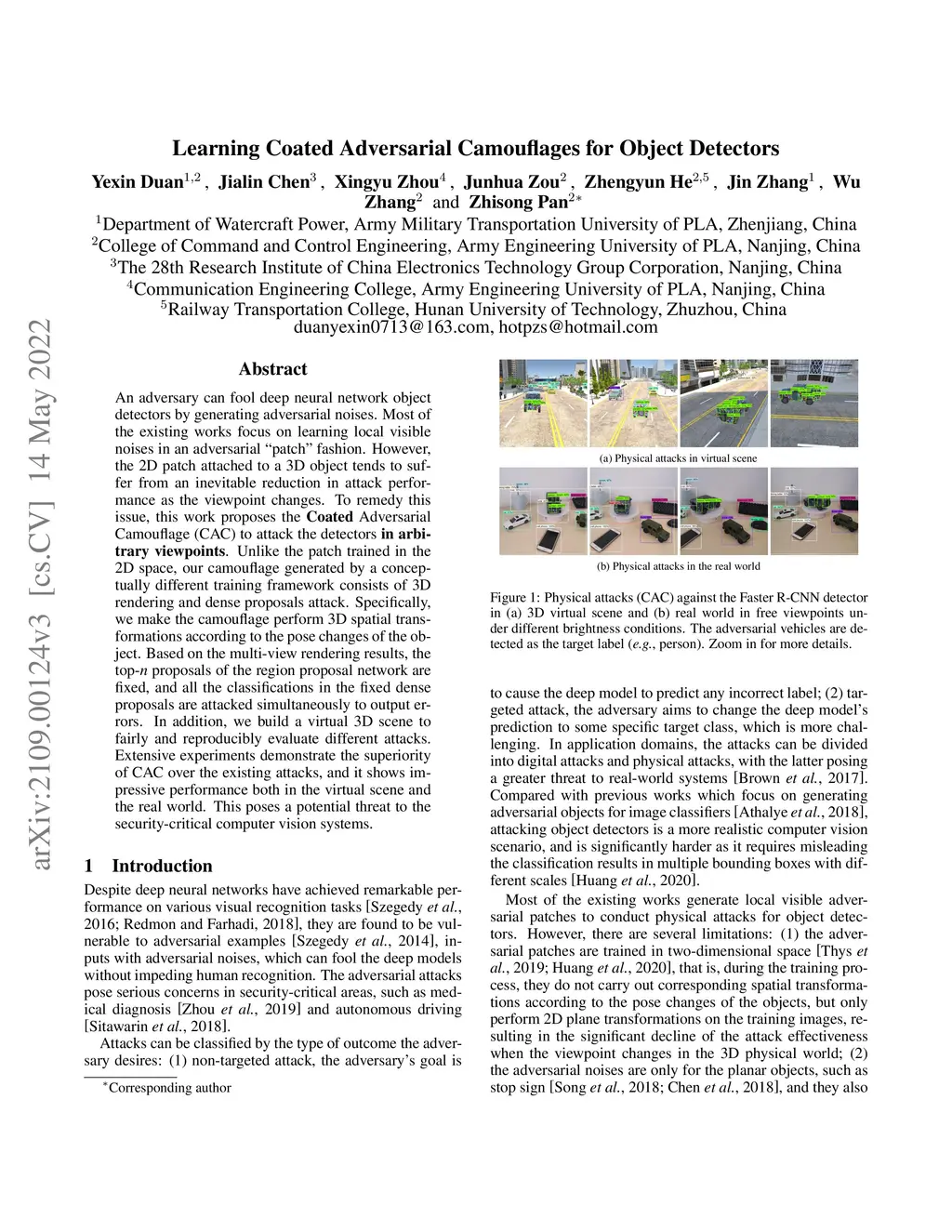
Adversarial attacks are feasible in the real world for object detection. However, most of the previous works have tried to learn local "patches" applied to an object to fool detectors, which become less effective in squint view angles. To address this issue, we propose the Dense Proposals Attack (DPA) to learn one-piece, physical, and targeted adversarial camouflages for detectors. The camouflages are one-piece because they are generated as a whole for an object, physical because they remain adversarial when filmed under arbitrary viewpoints and different illumination conditions, and targeted because they can cause detectors to misidentify an object as a specific target class. In order to make the generated camouflages robust in the physical world, we introduce a combination of transformations to model the physical phenomena. In addition, to improve the attacks, DPA simultaneously attacks all the classifications in the fixed proposals. Moreover, we build a virtual 3D scene using the Unity simulation engine to fairly and reproducibly evaluate different physical attacks. Extensive experiments demonstrate that DPA outperforms the state-of-the-art methods, and it is generic for any object and generalized well to the real world, posing a potential threat to the security-critical computer vision systems.
View on arXiv