
Infrastructure-free, Deep Learned Urban Noise Monitoring at 100mW
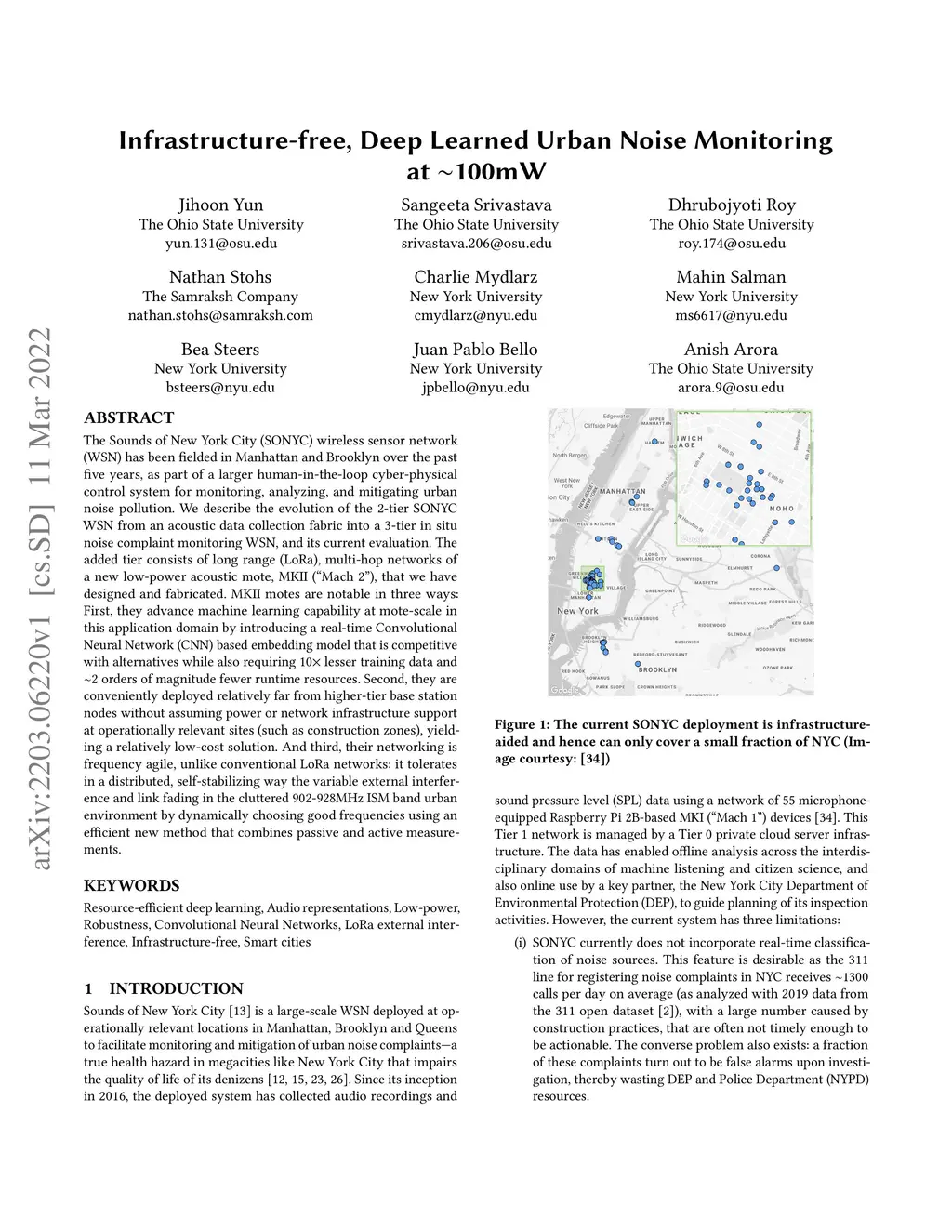
The Sounds of New York City (SONYC) wireless sensor network (WSN) has been fielded in Manhattan and Brooklyn over the past five years, as part of a larger human-in-the-loop cyber-physical control system for monitoring, analyzing, and mitigating urban noise pollution. We describe the evolution of the 2-tier SONYC WSN from an acoustic data collection fabric into a 3-tier in situ noise complaint monitoring WSN, and its current evaluation. The added tier consists of long-range (LoRa), multi-hop networks of a new low-power acoustic mote, MKII ("Mach 2"), that we have designed and fabricated. MKII motes are notable in three ways: First, they advance machine learning capability at mote-scale in this application domain by introducing a real-time Convolutional Neural Network (CNN) based embedding model that is competitive with alternatives while also requiring 10 lesser training data and 2 orders of magnitude fewer runtime resources. Second, they are conveniently deployed relatively far from higher-tier base station nodes without assuming power or network infrastructure support at operationally relevant sites (such as construction zones), yielding a relatively low-cost solution. And third, their networking is frequency agile, unlike conventional LoRa networks: it tolerates in a distributed, self-stabilizing way the variable external interference and link fading in the cluttered 902-928MHz ISM band urban environment by dynamically choosing good frequencies using an efficient new method that combines passive and active measurements.
View on arXiv