
Modeling Dual Read/Write Paths for Simultaneous Machine Translation
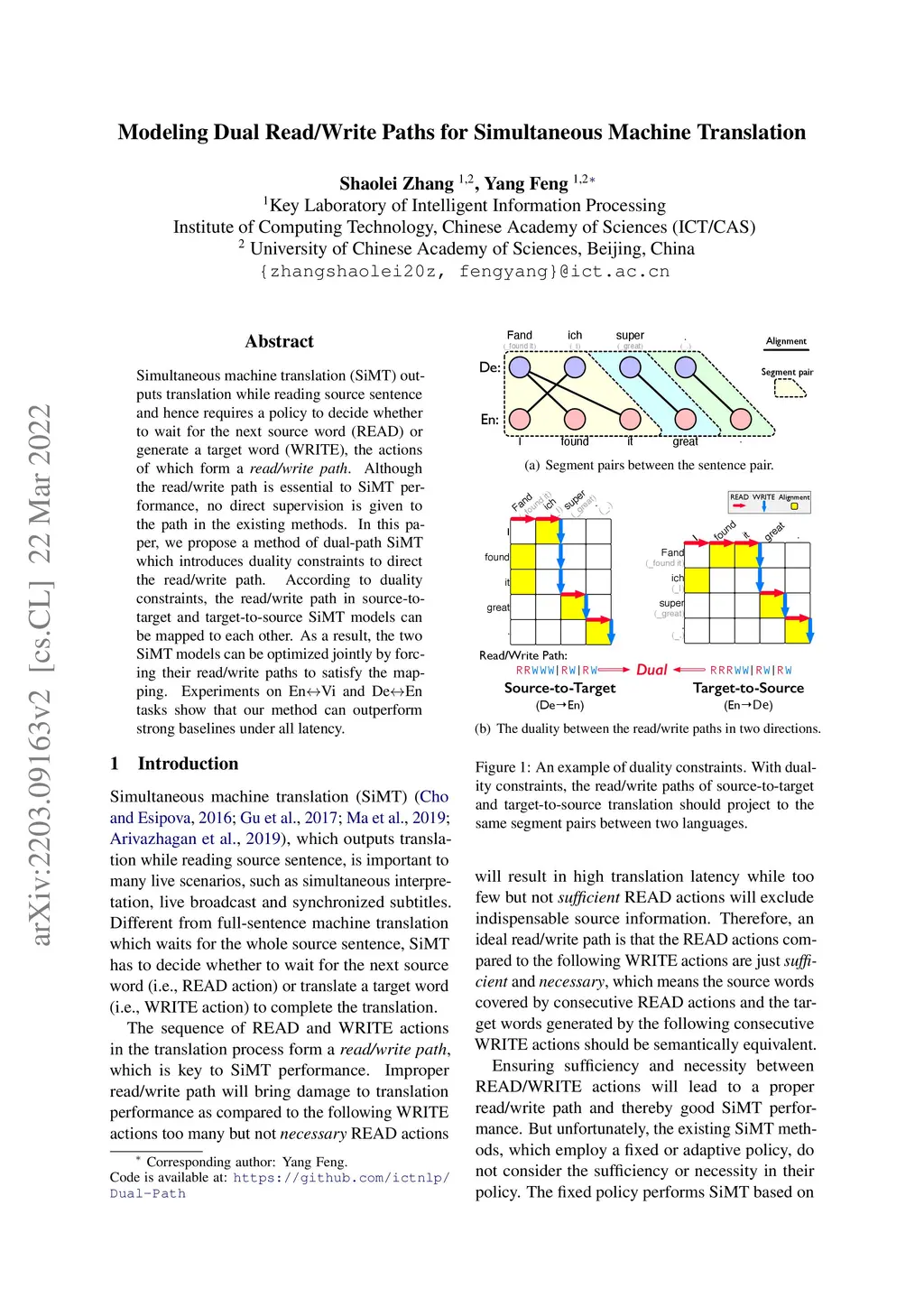
Simultaneous machine translation (SiMT) outputs the translation while reading the source sentence and hence requires a policy to determine whether to wait for the next source word (READ) or generate a target word (WRITE), the actions of which form a read/write path. Although the read/write path is essential to SiMT performance, there is no direct supervision given to the path in the existing methods. In this paper, we propose a method of Dual Path SiMT which introduces duality constraints to guide the read/write path. According to duality constraints, the read/write paths in source-to-target and target-to-source SiMT models can be mapped to each other. Therefore, the SiMT models in two directions are jointly optimized by forcing their read/write paths to satisfy the mapping relation. Experiments on En-Vi and De-En SiMT tasks show that our method can outperform strong baselines under all latency.
View on arXiv