
Perturbation Analysis of Randomized SVD and its Applications to Statistics
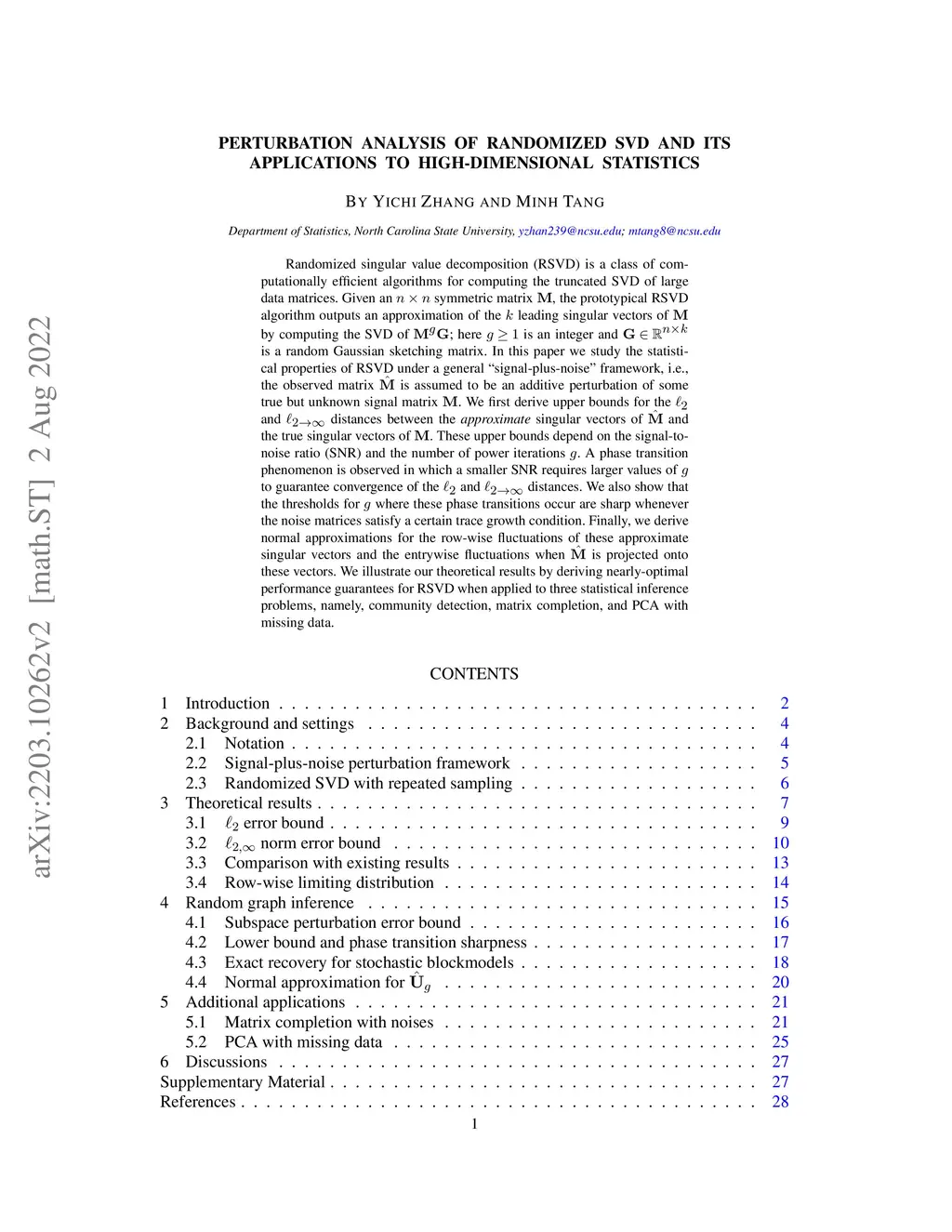
Randomized singular value decomposition (RSVD) is a class of computationally efficient algorithms for computing the truncated SVD of large data matrices. Given an matrix , the prototypical RSVD algorithm outputs an approximation of the leading left singular vectors of by computing the SVD of ; here is an integer and is a random Gaussian sketching matrix with . In this paper we derive upper bounds for the and distances between the exact left singular vectors of and its approximation (obtained via RSVD), as well as entrywise error bounds when is projected onto . These bounds depend on the singular values gap and number of power iterations , and smaller gap requires larger values of to guarantee the convergences of the and distances. We apply our theoretical results to settings where is an additive perturbation of some unobserved signal matrix . In particular, we obtain the nearly-optimal convergence rate and asymptotic normality for RSVD on three inference problems, namely, subspace estimation and community detection in random graphs, noisy matrix completion, and PCA with missing data.
View on arXiv