
Speculative Decoding: Lossless Speedup of Autoregressive Translation
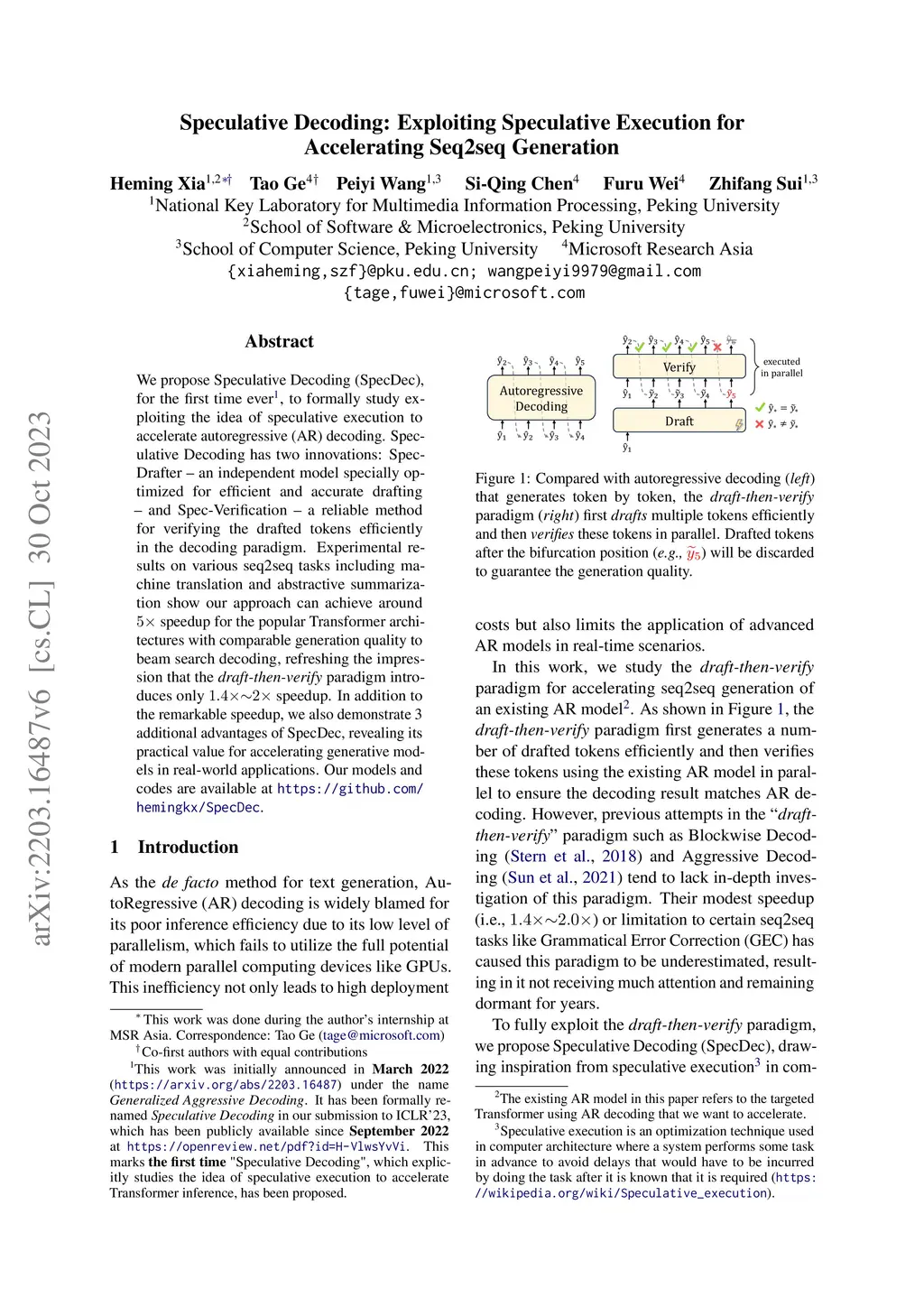
Different from some previous work accelerating autoregressive translation (AT) at the sacrifice of quality, we propose Speculative Decoding (SpecDec) -- a novel decoding paradigm inspired by speculative execution in computer architecture, which combines respective advantages of AT and non-autoregressive translation (NAT) for lossless speedup of translation. At each decoding step, SpecDec first speculatively drafts (i.e. decodes) next tokens with an NAT model and then verifies them with an AT model, where only the drafted tokens passing the verification are accepted as decoded tokens for guaranteeing its translation result is exactly the same as AT. The collaboration of NAT drafting and AT verification leads to a much higher decoding speed without quality loss due to parallel computing enabled by speculative decoding. We conduct experiments in 4 standard WMT translation benchmarks and confirm the vanilla SpecDec yields exactly the same results as AT greedy decoding with an around speedup, and that its variant (SpecDec++) with an advanced verification strategy not only outperforms AT greedy decoding, but also further improves the decoding speed, resulting in an around speedup over AT. Moreover, SpecDec can be easily generalized for speeding up other seq2seq tasks like Abstractive Summarization, and benefit more from stronger computing devices, demonstrating its potential to become a \textit{de facto} decoding standard in the future for efficient and lossless seq2seq generation. We will release all our codes and checkpoints to facilitate reproducing our results.
View on arXiv