
Sim-to-Real Learning of Compliant Bipedal Locomotion on Torque
Sensor-Less Gear-Driven Humanoid
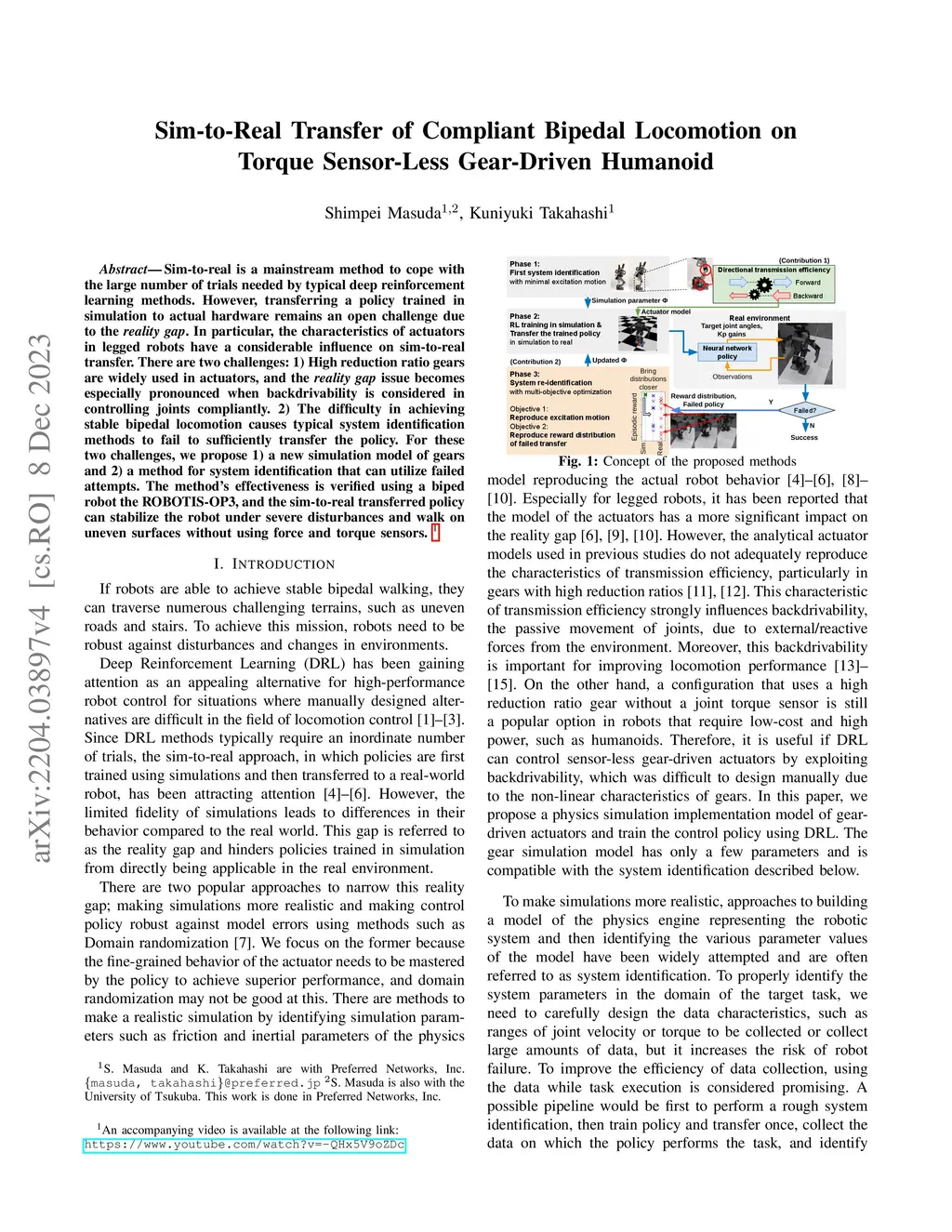
Sim-to-real is a mainstream method to cope with the large number of trials needed by typical deep reinforcement learning. However, transferring a policy trained in simulation to actual hardware remains challenging due to the reality gap. In particular, the characteristics of actuators in legged robots have a considerable influence on sim-to-real transfer. High reduction ratio gears are widely used in actuators, and the reality gap issue becomes especially pronounced when even the utilization of backdrivability is considered to control joints compliantly. We propose a new simulation model of gears to address this gap. Additionally, the difficulty in achieving stable bipedal locomotion causes typical methods to fail to tune physical parameters in simulation with the behavior of transferred policy. Thus, we propose a method for system identification that can utilize failed attempts. The method's effectiveness is verified using a biped robot, the ROBOTIS-OP3, and the sim-to-real transferred policy can stabilize the robot under severe disturbances and walk on uneven surfaces without force and torque sensors.
View on arXiv