
Understanding Gradual Domain Adaptation: Improved Analysis, Optimal Path
and Beyond
- OODCLL
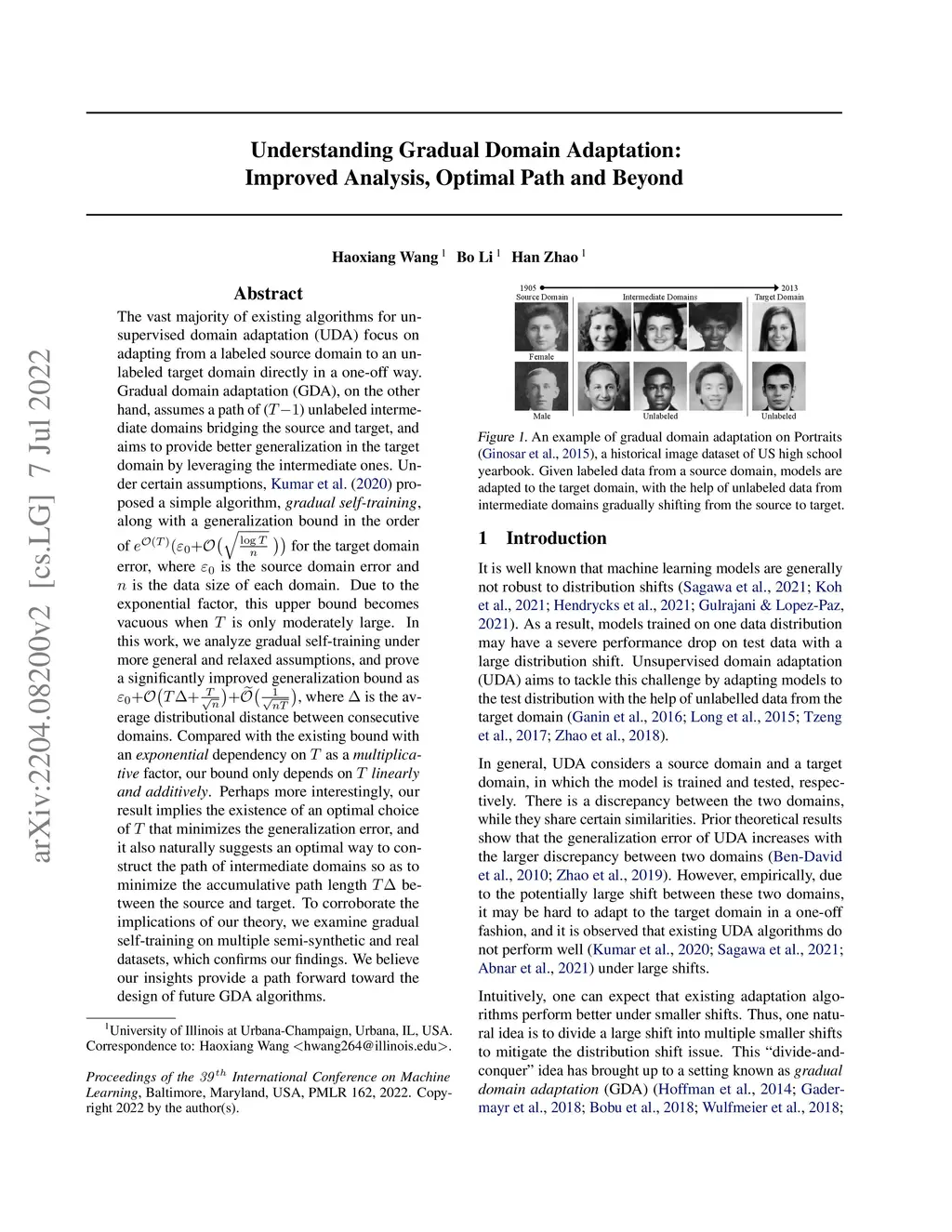
The vast majority of existing algorithms for unsupervised domain adaptation (UDA) focus on adapting from a labeled source domain to an unlabeled target domain directly in a one-off way. Gradual domain adaptation (GDA), on the other hand, assumes a path of unlabeled intermediate domains bridging the source and target, and aims to provide better generalization in the target domain by leveraging the intermediate ones. Under certain assumptions, Kumar et al. (2020) proposed a simple algorithm, Gradual Self-Training, along with a generalization bound in the order of for the target domain error, where is the source domain error and is the data size of each domain. Due to the exponential factor, this upper bound becomes vacuous when is only moderately large. In this work, we analyze gradual self-training under more general and relaxed assumptions, and prove a significantly improved generalization bound as , where is the average distributional distance between consecutive domains. Compared with the existing bound with an exponential dependency on as a multiplicative factor, our bound only depends on linearly and additively. Perhaps more interestingly, our result implies the existence of an optimal choice of that minimizes the generalization error, and it also naturally suggests an optimal way to construct the path of intermediate domains so as to minimize the accumulative path length between the source and target. To corroborate the implications of our theory, we examine gradual self-training on multiple semi-synthetic and real datasets, which confirms our findings. We believe our insights provide a path forward toward the design of future GDA algorithms.
View on arXiv