
A Unifying Framework for Combining Complementary Strengths of Humans and
ML toward Better Predictive Decision-Making
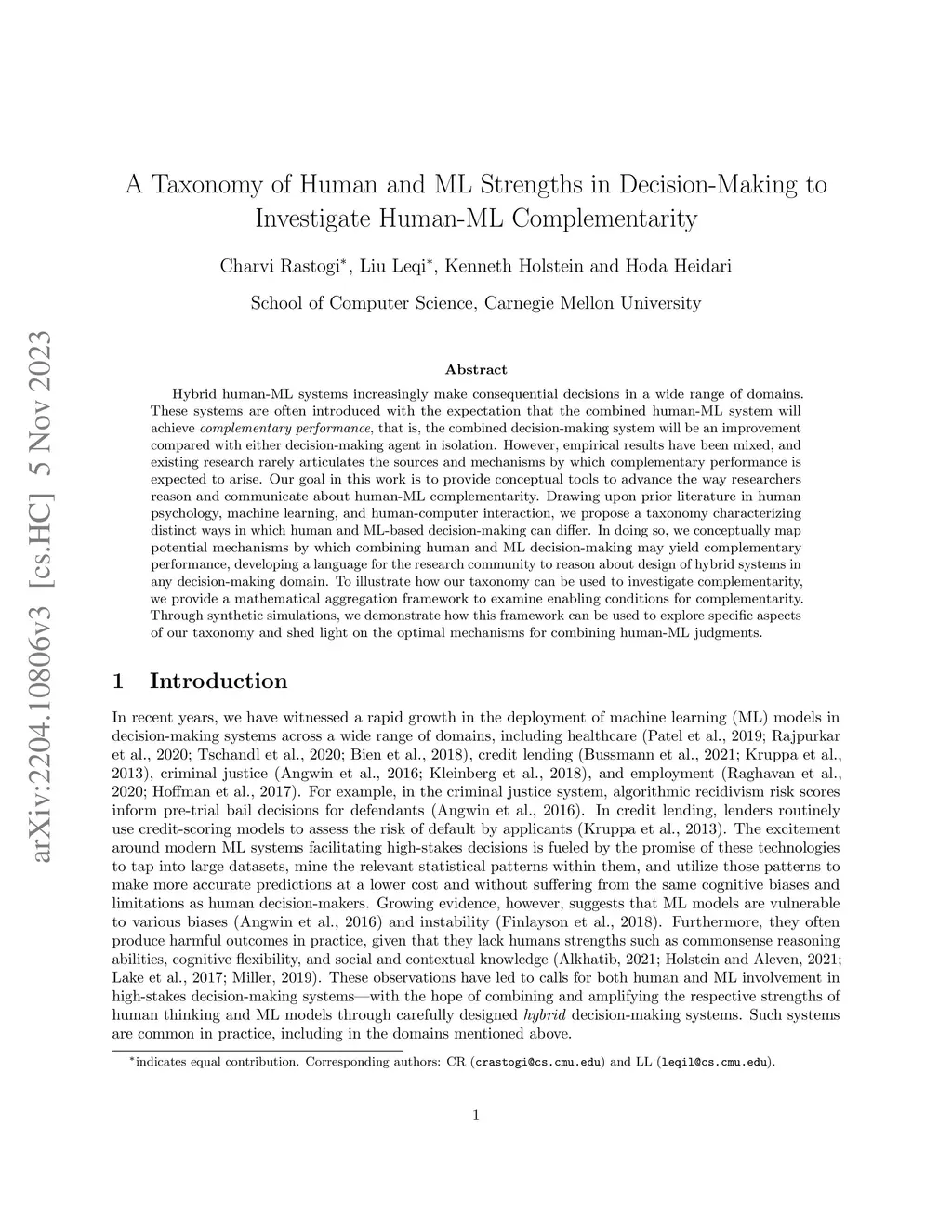
Hybrid human-ML systems are increasingly in charge of consequential decisions in a wide range of domains. A growing body of empirical and theoretical work has advanced our understanding of these systems. However, existing empirical results are mixed, and theoretical proposals are often mutually incompatible. In this work, we propose a unifying framework for understanding conditions under which combining the complementary strengths of humans and ML leads to higher quality decisions than those produced by each of them individually -- a state which we refer to as human-ML complementarity. We focus specifically on the context of human-ML predictive decision-making and investigate optimal ways of combining human and ML predictive decisions, accounting for the underlying sources of variation in their judgments. Within this scope, we present two crucial contributions. First, taking a computational perspective of decision-making and drawing upon prior literature in psychology, machine learning, and human-computer interaction, we introduce a taxonomy characterizing a wide range of criteria across which human and machine decision-making differ. Second, formalizing our taxonomy allows us to study how human and ML predictive decisions should be aggregated optimally. We show that our proposed framework encompasses several existing models of human-ML complementarity as special cases. Last but not least, an initial exploratory analysis of our framework presents a critical insight for future work in human-ML complementarity: the mechanism by which we combine human and ML judgments should be informed by the underlying causes of divergence in their decisions.
View on arXiv