
Bandwidth Cost of Code Conversions in the Split Regime
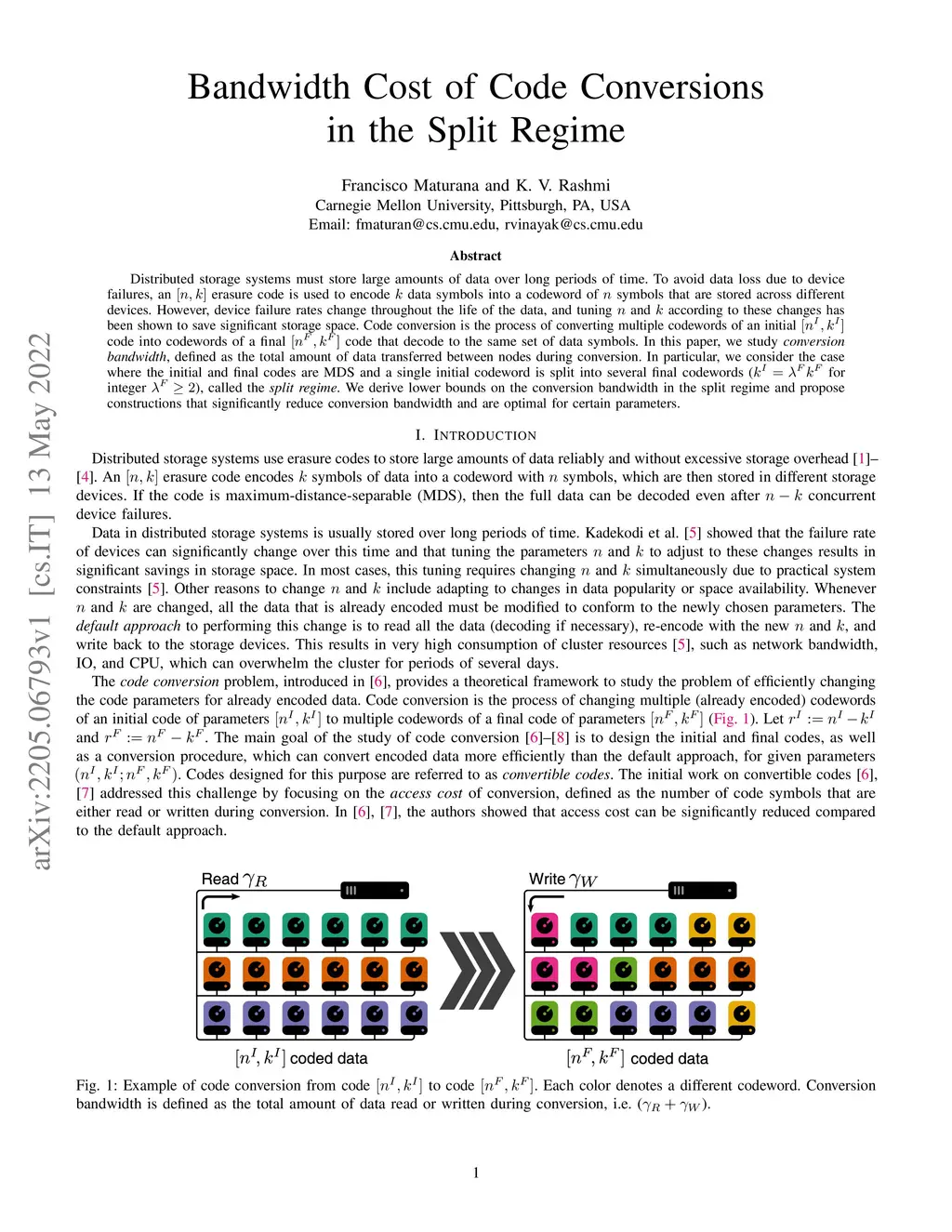
Distributed storage systems must store large amounts of data over long periods of time. To avoid data loss due to device failures, an erasure code is used to encode data symbols into a codeword of symbols that are stored across different devices. However, device failure rates change throughout the life of the data, and tuning and according to these changes has been shown to save significant storage space. Code conversion is the process of converting multiple codewords of an initial code into codewords of a final code that decode to the same set of data symbols. In this paper, we study conversion bandwidth, defined as the total amount of data transferred between nodes during conversion. In particular, we consider the case where the initial and final codes are MDS and a single initial codeword is split into several final codewords ( for integer ), called the split regime. We derive lower bounds on the conversion bandwidth in the split regime and propose constructions that significantly reduce conversion bandwidth and are optimal for certain parameters.
View on arXiv