
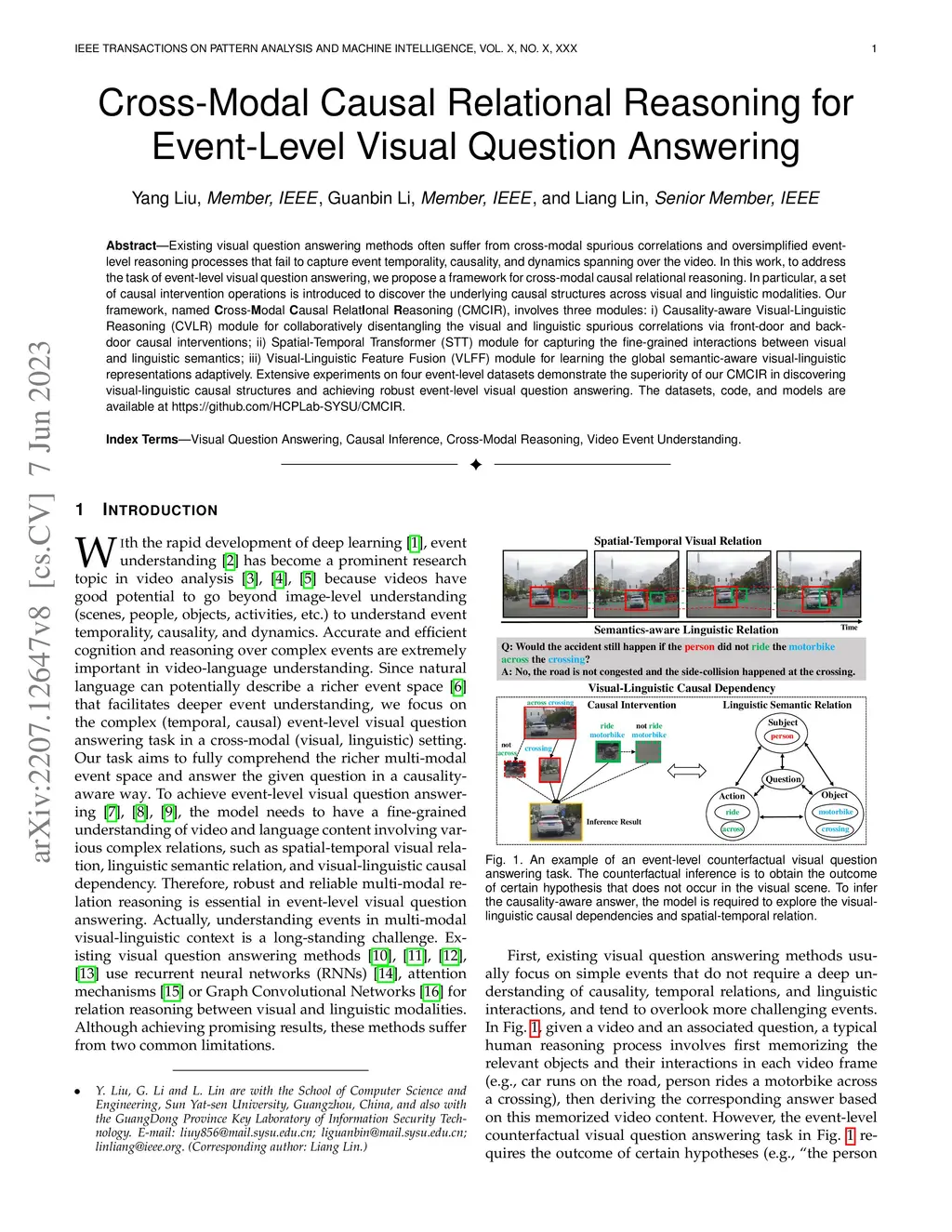
Existing visual question answering methods tend to capture the cross-modal spurious correlations, and fail to discover the true causal mechanism that facilitates reasoning truthfully based on the dominant visual evidence and the question intention. Additionally, the existing methods usually ignore the cross-modal event-level understanding that requires to jointly model event temporality, causality, and dynamics. In this work, we focus on event-level visual question answering from a new perspective, i.e., cross-modal causal relational reasoning, by introducing causal intervention methods to discover the true causal structures for visual and linguistic modalities. Specifically, we propose a novel event-level visual question answering framework named Cross-Modal Causal RelatIonal Reasoning (CMCIR), to achieve robust causality-aware visual-linguistic question answering. To discover cross-modal causal structures, the Causality-aware Visual-Linguistic Reasoning (CVLR) module is proposed to collaboratively disentangle the visual and linguistic spurious correlations via front-door and back-door causal interventions. To model the fine-grained interactions between linguistic semantics and spatial-temporal representations, we build a Spatial-Temporal Transformer (STT) that builds the multi-modal co-occurrence interactions between visual and linguistic content. To adaptively fuse the causality-ware visual and linguistic features, we introduce a Visual-Linguistic Feature Fusion (VLFF) module that leverages the hierarchical linguistic semantic relations as the guidance to learn the global semantic-aware visual-linguistic representations adaptively. Extensive experiments on four event-level datasets demonstrate the superiority of our CMCR for discovering visual-linguistic causal structures and achieving robust event-level visual question answering.
View on arXiv